Trust the Design Process—New Book Improves Your Interiors Project Experience and Outcomes
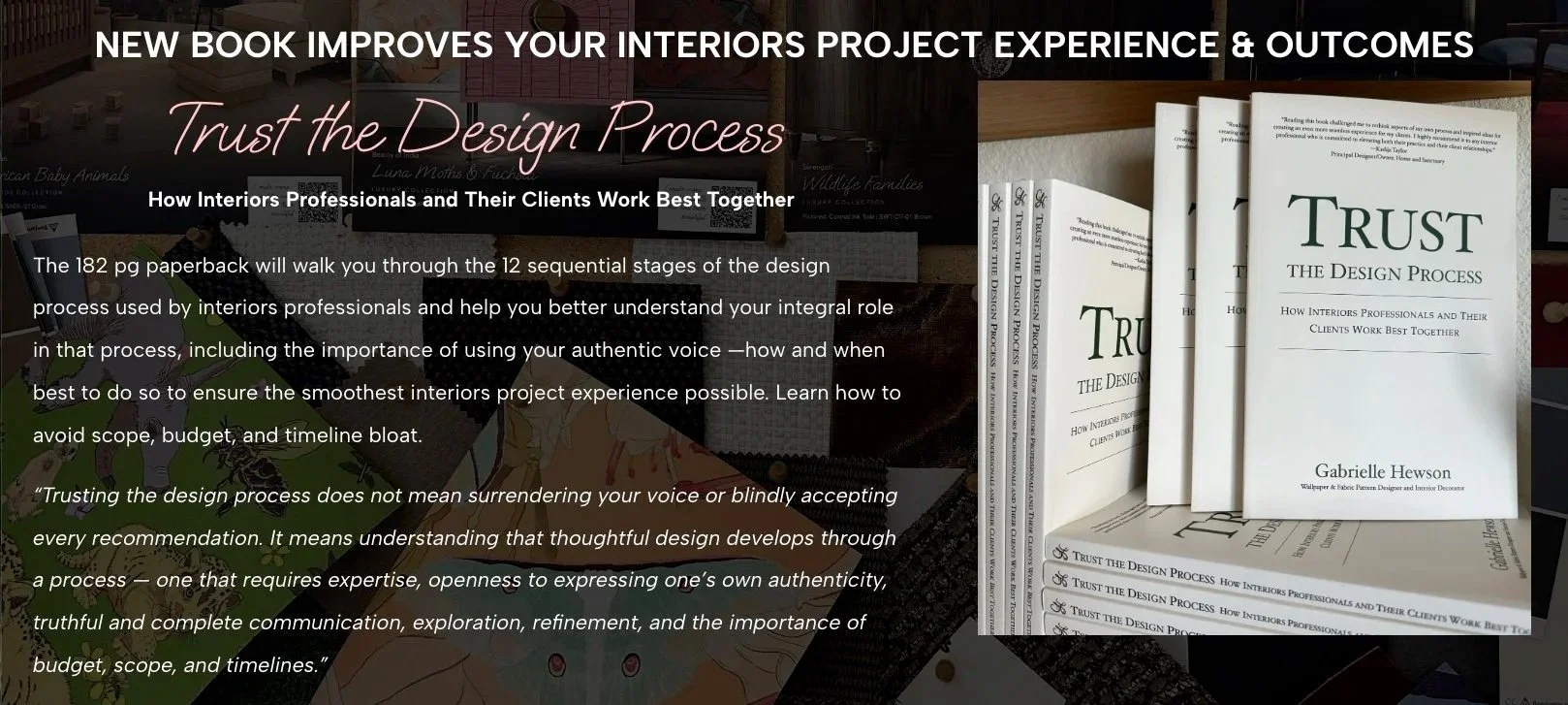
CLICK IMAGE ABOVE TO PURCHASE BOOK
A Book About the Working Relationships That Make Beautiful Rooms Possible
Every interiors project begins with optimism. There are ideas to explore, possibilities to uncover, colors to consider, materials to touch, and a vision waiting to become reality. And then the work begins.
Decisions have to be made. Budgets meet ambitions. Lead times enter the conversation. Something a client thought would happen in one stage actually belongs in another. A decision believed to be settled gets reopened. A professional is asked to solve a problem that falls outside their role. A seemingly simple change ripples through work already completed.
The cause of these and other avoidable issues that result in scope, budget, and timeline bloat is a lack of understanding the design process, the roles of everyone who will be involved, and reasonable expectations for the progress and outcome of the interiors project.
Over the years, through my own work in interiors and conversations with interiors professionals—interior designers and interior decorators—and clients, I kept hearing variations of the same challenges. Questions left unasked. Decisions revisited after they'd already been made. Roles that weren't fully understood. Expectations that were never clearly defined. Frustration arising not because someone wasn't doing their job well, but because the people involved didn't always understand how the pieces of an interiors project fit together—or why they happen in the order they do. These aren’t one-offs. They actually plague many interiors projects—but they don’t need to. We spend an enormous amount of time talking about what makes a beautiful interior, but considerably less time talking about the working relationships and processes that allow one to be created. That’s why I wrote Trust the Design Process: How Interiors Professionals and Their Clients Work Best Together.
Why the Process Matters
The book follows the twelve distinct and sequential stages of an interiors project, from discovery through final layering. Within it I not only explain what happens at each stage, I illuminate why each stage exists, expectations for each stage, what needs to be accomplished before moving forward to the next stage, and how each of the decisions approved and signed off on affects everything that follows. Because sequence matters. Sampling before approval matters. Approval before procurement matters. Clear scope matters. Knowing who is responsible for what matters. Understanding when a decision can still be reconsidered—and when changing it carries consequences—matters. None of this diminishes creativity. It protects it.
Interior designer Shannon Allen of Shannon Allen Design in New Prague, Minnesota, recognized this immediately while reading an advance copy. What stood out to her was the book's willingness to address something that is often tiptoed around: both the interiors professional and the client have responsibilities within a successful project. She appreciated that the book doesn't "sugar coat" the ways a homeowner's behavior, reactions, decisions, and involvement can alter the dynamic of a project—sometimes enough, as she observed, to send both a good design and a good working relationship into a spiral. That honesty is deliberate.
Trusting the design process doesn't mean a client relinquishes their voice. Quite the opposite. Clients deserve to be heard, to ask questions and understand what is happening in their home or small business—and why.
But a productive collaboration also requires understanding when input is needed, when decisions become approvals, what happens when those decisions are revisited, and when the professional entrusted with a particular area of expertise needs the room to exercise it. Shannon put the larger issue succinctly: "I don't think the process or expectation of both parties is discussed enough prior to committing to a working relationship." That observation reaches the heart of why I wrote this book.
Before the Problems Begin
Many of the difficulties that emerge midway through an interiors project actually have roots much earlier. Before the first fabric is ordered. Before the contractor begins work. Before installation day. Sometimes before the professional and client have even agreed to work together. As Shannon noted, professionals can be so eager to begin a project that establishing guidelines, expectations, and best practices doesn't always receive the attention it deserves. Trust the Design Process brings those conversations forward. What does the client need to understand before committing to a project? What does the professional need to communicate? What decisions belong at each stage? What is still flexible? What has become a stable layer upon which later decisions now depend? And what can happen to schedule, cost, scope, or design when an earlier decision is reopened These aren't simply procedural questions. They shape the relationship. And that relationship shapes the project.
Who Does What—and Why Does It Matter?
The design industry itself can be confusing from the outside. Trust the Design Process introduces the many professionals a client may encounter throughout a project and explains the expertise each brings to the work: interior designers, interior decorators, architects, interior architects, general contractors, project managers, design-build firms, kitchen designers, lighting professionals, wallpaper and fabric designers, installers, workrooms, fabricators, and others.
Kadija Taylor, principal designer and owner of Home and Sanctuary in Denver, Colorado, singled out this portion of the book when she read her copy. She described the explanations as providing clarity that is often missing not only for clients, but also for newer design professionals. Shannon saw similar value, noting how useful it is for clients to understand the possibilities each type of professional brings to a project. These distinctions matter. Knowing the difference between professional roles helps a client assemble the right team, understand where particular expertise resides, know whom to approach with a question, and appreciate why several specialists may contribute to what appears, from the outside, to be a single design decision. It also helps establish something essential to a successful project: respect for expertise.
One of Kadija's favorite discussions in the book was about why allowing professionals to do their jobs ultimately leads to better outcomes. That isn't an argument for blind deference. It's an argument for informed trust. Choose professionals carefully. Ask questions. Understand their expertise and their process. Together, establish expectations and, above all, communicate honestly. Then allow the professional you've hired for their knowledge and experience, to bring that knowledge and experience to the work.
Twelve Stages, With a Reason for Every One
Kadija was particularly drawn to the book's twelve-stage framework and its intentional progression through an interiors project. Each stage explains what is happening, what needs to be accomplished, and what the professional and client should understand before proceeding. End-of-chapter check-ins give readers an opportunity to consider whether they're actually ready to move forward rather than simply assuming they are. That’s enormously important.
Moving forward isn't the same as being ready to move forward. A decision that feels small in isolation may become the foundation for several decisions that follow it. Understanding those dependencies helps clients see why interiors professionals establish processes in the first place—and helps professionals examine whether their own processes communicate those dependencies clearly enough. Kadija discovered that while reading the book herself. Despite being an experienced interior designer, she found herself reflecting on her own client experience and identifying places where additional education or clearer expectations could make that experience even stronger.
In her endorsement, she wrote: “Trust the Design Process* is an invaluable resource for interior professionals looking to strengthen and refine their client experience." She went on to say that reading it "challenged me to rethink aspects of my own process and inspired ideas for creating an even more seamless experience for my clients." For me, that is one of the most meaningful responses this book could have received. Because this isn't only a book for someone who doesn't understand the design process yet. It can also be a mirror for those of us already working within it.
A Resource for Both Sides of the Relationship
Shannon described Trust the Design Process as "a raw, honest guide" for helping homeowners and design professionals work together more cohesively. She also saw its usefulness across project sizes. While particularly valuable for clients undertaking a large scope of work, the principles don't disappear simply because a project is smaller. Communication, expectations, decision-making, professional roles, and trust still matter.
For professionals, the book can be a resource for examining and refining the client experience, thinking more deliberately about how expectations are established, and identifying conversations worth having before problems arise.
For homeowners, it offers a view behind the curtain. It explains why the process works as it does; what may be happening long before something visible appears in the room; why decisions have an order; why changing one selection can affect several others; what the different people working on a project actually do; and why trusting carefully chosen professionals is such an important part of achieving the result everyone wants.
Perhaps most importantly, Trust the Design Process gives both sides a common language for conversations that are much easier to have before something goes wrong.
It’s All About What Gets Us to Beautiful Rooms
When expectations are clear, expertise is respected, communication remains open, and trust is established early, something changes. The process becomes less adversarial and more collaborative. Decisions have context. Questions are easier to ask. Problems can be addressed without immediately becoming conflicts. Professionals are better able to do the work they were hired to do, and clients can participate in creating their spaces with greater understanding and confidence.
As Shannon wrote, relationships are at the core of her design business, and while the stages themselves are imperative, "honest communication is a key factor for the outcome of a well executed project."
Exactly.
Beautiful rooms may be what we ultimately see. Yet, behind them are hundreds—sometimes thousands—of decisions, conversations, revisions, measurements, samples, approvals, orders, schedules, tradespeople, craftspeople, deliveries, installations, and moments of expertise that most will never see in the finished photograph.
Trust the Design Process is about that part. It's about what happens between the first conversation and the finished room—and how interiors professionals and their clients can move through it together with greater clarity, respect, and trust.
The conversations that inspired this book came from real projects, real frustrations, real misunderstandings, and many thoughtful conversations with interiors professionals who care deeply about doing this work well, and the clients they serve. With this book I hope to widen that conversation.
Trust the Design Process: How Interiors Professionals and Their Clients Work Best Together is now available online HERE.
Because beautiful interiors begin when all of us seek to understand how we can work well together.
After you’ve read the book, please leave your comments below—I’d love to hear from you.