The Psychology of Pattern: Why Humans Are Comforted by Repetition
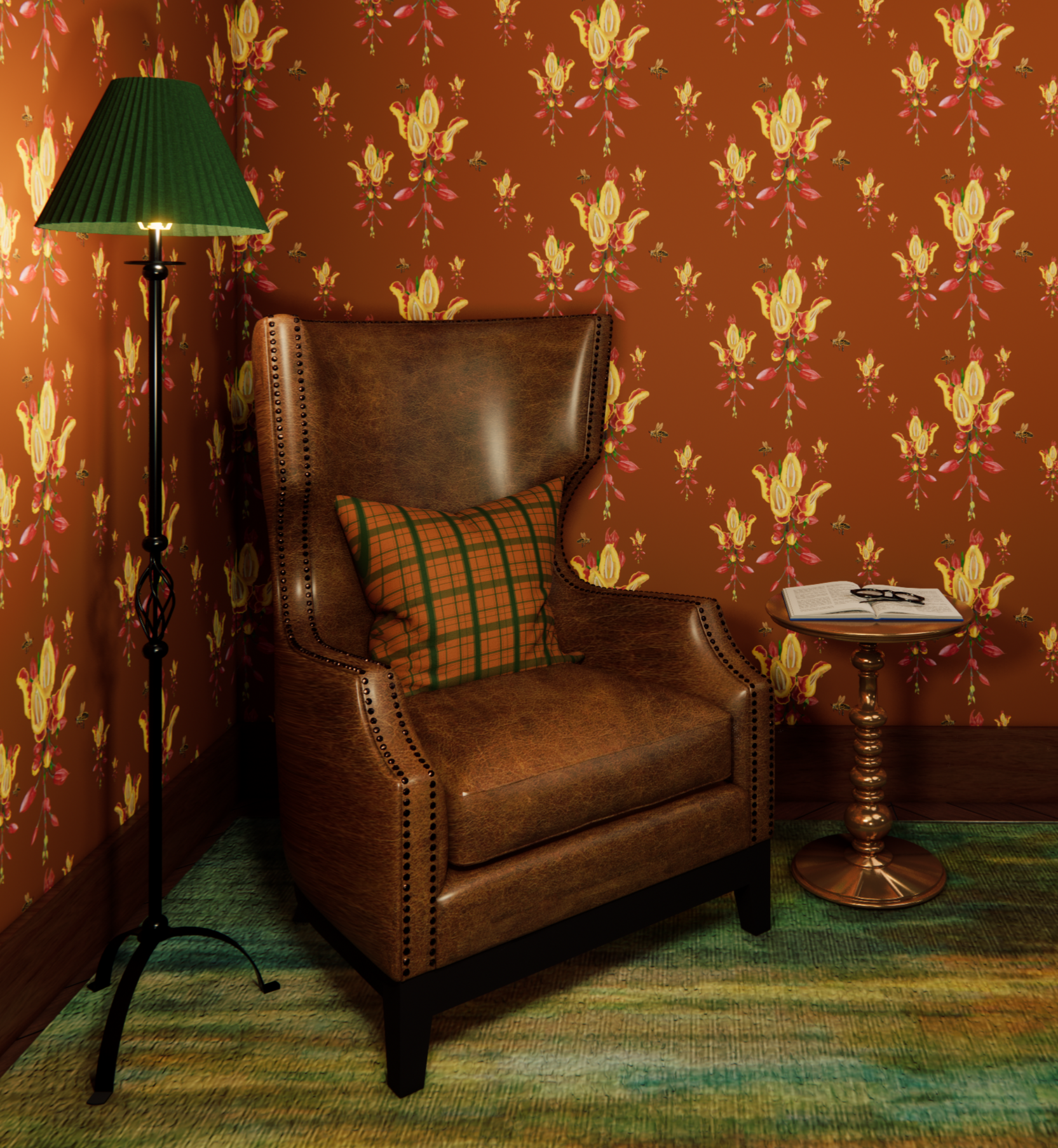
A calm, softly lit reading nook with a mid-scale repeating wallpaper pattern (Exotic Florals - Indian Brick & Butter Vine on Terra Cotta), layered supporting textures like a faux-leather high-backed reading chair with a comfy patterned throw pillow in a matching plaid that echoes colors from the wall. The space feels lived-in, but tidy and composed—inviting, not styled within an inch of its life.
Patterns as reassurance is what our brains are looking for in a room
The pull of repetition: a designer’s everyday neuroscience.
Even if we never mention neuroscience, we work with it constantly. Our brains are wired to scan for patterns—rhythm, repetition, and familiar motifs are how we decide very quickly whether an environment feels safe or uncertain.
In an interior, a repeating motif does a few quiet jobs at once:
It gives the eye a clear, predictable rhythm to follow.
It helps the brain anticipate what’s coming next in the visual field.
It gently reduces the amount of “figuring out” a person has to do when they walk into the space.
That’s why a well-placed wallpaper or a repeated fabric story can calm a room down, even when the palette is lively. Predictability, handled with care, feels like safety.
Why repetition feels safe rather than humdrum
The human brain is constantly running a threat assessment, even in a beautifully finished living room. Anything too chaotic, jagged, or unpredictable demands extra attention. Repetition works like a visual lullaby: “You’ve seen this before. It continues the same way. You can relax.”
In our projects, we see this show up in a few specific ways:
Scale and spacing - When the repeat is consistent—whether loose and painterly or crisp and geometric—the brain can quickly map it. Even highly expressive motifs feel calmer when the spacing is even and the rhythm is clear.
Echoed shapes - When we repeat a curve from a floral wallpaper in a lamp base, or reflect a stripe from a fabric into a rug pattern, we’re telling the brain, “Yes, you’re still in the same story.” Those echoes quietly reduce visual noise.
Familiarity over novelty - Repetition gives a foothold: even a new motif feels friendlier when it clearly repeats across the wall or drapery rather than behaving unpredictably.
Comfort, memory, and the patterns we grew up with
Patterns don’t just operate at the level of rhythm—they also hold memory. Many of us can instantly recall wallpaper or a sofa fabric from childhood homes, grandparents’ dining rooms, or a favorite hotel. Those memories are often tied to safety, celebration, or family rituals.
When introducing repeating pattern into a space, a few things can happen:
Emotional shorthand - A classic stripe, a stylized botanical, a soft check—these carry cultural and personal associations. The repeat amplifies those associations every time the motif appears.
“Lived-in” from day one - A bare wall reads as a blank page. A patterned wall or fabric suggests a story already in progress, which can help a new house feel less raw for clients who are craving a sense of home.
Cultural and regional cues - Certain repeats reference place—coastal, urban, rural, or international influences. Used with intention, that repetition can anchor a space in a specific mood or context without us having to over-explain it to the client.
The difference between soothing repetition and visual overload
Of course, repetition can also tip into overwhelm. The goal is to manage how much repetition, at what scale, and where.
A few principles I’ve found that tend to keep repetition comforting rather than chaotic:
• Vary scale while repeating a theme - If the wallpaper carries a mid-scale botanical, echo it in a smaller-scale coordinate on cushions or a bench seat, and perhaps a large-scale, simplified version in art. The theme repeats, but the eye gets a natural hierarchy.
• Keep at least one “quiet” surface in the mix - Not every plane needs to participate in the pattern story. A quieter floor, ceiling, or solid upholstery allows the repeating motifs to breathe.
• Limit the number of “families” of pattern - Many spaces feel calmer when we choose one or two pattern families (for example, florals plus stripes, or geometrics plus solids) and repeat those thoughtfully, rather than introducing many unrelated motifs.
• Use color as the anchor - When the palette is disciplined, the brain experiences the space as cohesive, even if several patterns are repeating at once.
How pattern repetition supports the nervous system
You might be hearing more and more about overwhelm, sensory fatigue, and the desire for spaces that feel regulating rather than stimulating. Pattern is an under-discussed tool for this.
Used well, repeating pattern can:
Provide a soft focus point - A rhythmic, organic repeat on a feature wall gives the eye somewhere safe to land. It’s interesting enough to hold attention, gentle enough not to demand it.
Reduce decision fatigue - When a motif flows from wall to cushion to window treatment in a considered way, the space reads as “sorted.” Clients don’t feel the same urge to keep tweaking because the visual logic is already in place.
Add containment and “hug” - In certain rooms—bedrooms, snug living rooms, reading corners—wrapping more surfaces in pattern can create a cocooning effect. The repetition becomes a kind of visual envelope, which can feel deeply comforting.
Designing with repetition: practical applications for interiors
When the psychology of repetition is brought down into the specification phase of a project, it becomes very actionable. A few approaches that tend to work well across projects:
Choose a primary repeat and a supporting repeat - Let one wallpaper or fabric lead the story. Build a supporting cast of stripes, checks, or smaller-scale motifs that repeat its geometry or palette without competing.
Repeat through placement, not just product - Even when every item isn’t patterned, we can create repetition through how we place them: pairs of lamps, book stacks arranged in similar heights, repeated silhouettes in side tables or chairs.
Use pattern to bridge old and new - In projects where we’re working with existing pieces, a repeating wallpaper or textile can tie disparate elements together. The motif becomes a mediator between an inherited piece and a new purchase.
Think explicitly - “Will this repeat give the room a gentle rhythm that enables the eye to follow it and rest.” That language helps them understand why they’re responding so positively.
When to lean into bold repetition
Comfort doesn’t always mean quiet. Sometimes a confident, high-contrast repeat is exactly what a space needs. In those cases, a few design moves can keep things grounded:
Pair a bold repeat with very simple forms in furniture.
Keep metal finishes and woods streamlined so the pattern can lead.
Repeat one accent color consistently so the space feels intentional, not accidental.
The goal isn’t to neutralize the pattern’s energy, but to give it a clear framework so the experience is energizing rather than jarring.
If you’re exploring a project where pattern and repetition need to do some of the emotional heavy lifting—whether that’s a full decorating engagement or developing custom wallpaper and fabric for a space—I’d be glad to talk about collaborating. You can reach out to me to start a conversation about your next project.
Ready to see these patterns in person? You can purchase samples by clicking “Request A Sample” at the bottom of any collection page on my website. You can check out my curated wallpaper and fabric collections.
Subscribe to Surface & Space for new articles in your inbox and instant access to two free printable substrate guides (wallpaper & fabric), plus a bonus PDF on Conscious Creators of Gentle Textiles.
© 2025-2026 Gabrielle Hewson. All rights reserved. You’re welcome to share links to this article, but please don’t copy or republish the text or images without my written permission. For licensing, permissions, or any other use beyond linking, please contact me directly.