The Life of an Interior Decorator: The End-to-End Experience of Working With an Interior Decorator and Why They Ask or Tell You What They Do
Working with an interior decorator is not just “picking pillows” or “adding a few pretty things.” It’s an end-to-end process designed to take you from fuzzy ideas to a finished space that feels like you—and works for those using the space every day. Along the way, your decorator will ask specific questions, set boundaries, and occasionally say, “Here’s what I recommend.” In this post, I’m walking through what that experience can look like, and why decorators ask (and tell) you what they do.
From “Can you just quickly…” to “Oh, this is a whole process—and I’m glad it is.”
Step 1: Discovery – getting what’s in your head out onto the table
Every good decorating project starts with questions, not with shopping.
In the discovery phase, a decorator will typically:
Ask how those using the space actually live there (who, when, how often, and for what).
Ask what you love—and don’t love—about the current room.
Look at inspiration images and listen for themes: color comfort zones, pattern tolerance, formality level.
Clarify budget and timeline, even if—at first—those using the space only have rough ranges or a general sense of what feels comfortable.
You might hear questions like:
“Where do you tend to drop your bag when you come home?”
“Where do you drink coffee or check email?”
“What feels missing in this room right now?”
The goal here isn’t to be nosey; it’s to collect the information needed to design spaces that support real life, not just a pretty photo
Step 2: Concept – pulling preferences into a clear story
Once the decorator understands how the space is used and what feels right aesthetically, they translate that into a direction. This is where you go from: “We like blue, we like cozy, we like light…” to something more like: “This living room will feel layered, calm, and conversational, with soft blues, warm woods, and one bold pattern moment.”
In the concept phase, you’ll usually see or hear about:
A rough color palette.
An overall mood (tailored, collected, airy, moody, playful, etc.).
Big-picture ideas about layout and key pieces (sofa vs. sectional, chairs vs. bench, where the main conversation area lands).
You may feel your decorator gently nudging you here:
Explaining why a certain direction supports the architecture or light.
Suggesting a small stretch outside your comfort zone where it will really pay off.
They’re not ignoring your preferences; they’re editing them into something coherent and livable.
Step 3: Design & selections – details, fabrics, and “future potential”
This is where interior decorating becomes very real: fabrics, wallpapers, furniture, art, lighting, and styling details are chosen and grouped into a unified scheme.
As a decorator, I will typically:
Develop upholstery, fabric, and wallpaper combinations that support the overall concept.
Consider durability, cleanability, and comfort alongside aesthetics.
Think carefully about how pattern, color, and texture will shape the daily experience of those using the space.
When I’m collaborating with an interior designer, we divide responsibilities intentionally. If a piece of existing furniture has what I like to call “future potential”—it’s structurally sound, the scale works, and reupholstery would add both visual life and longevity—that’s where I step in and take the lead. I work with those existing pieces, planning new fabrics and finishes so they feel fully integrated into the designer’s overall vision.
If a project calls for new furnishings, and the interior designer’s expertise and scope already include sourcing and specifying those pieces, I defer to them. I can suggest possible replacements or highlight where a new piece may serve the space better, but I’m not there to override a designer who is already managing furnishings, budget, and procurement.
In other words:
I focus on unlocking the potential of what’s already there through reupholstery and soft goods.
I offer suggestions on wallpaper, rugs, lighting, new furniture, and accessories only as requested and needed, especially on projects that have already been shaped by an interior designer and architect.
I also talk about flooring, paint, and trim, if needed and an interior designer isn’t already on board.
The goal is to support the overall design, not duplicate services or crowd the lane of the professional who is already leading on construction and new furnishings.
Step 4: Presentation – seeing the whole picture (without drawing or renderings)
A strong decorator will show you the room as a complete story, but that doesn’t always mean computer aided design (CAD) drawings or 3D renderings. The aim is to help those using the space clearly visualize how everything will work together.
In my own practice, I may provide a rough floor plan to illustrate furniture placement and flow, but this is always a conceptual tool—it does not replace architectural drawings or interior designer CAD. It’s there to help you imagine how the room will feel and how pieces relate to one another.
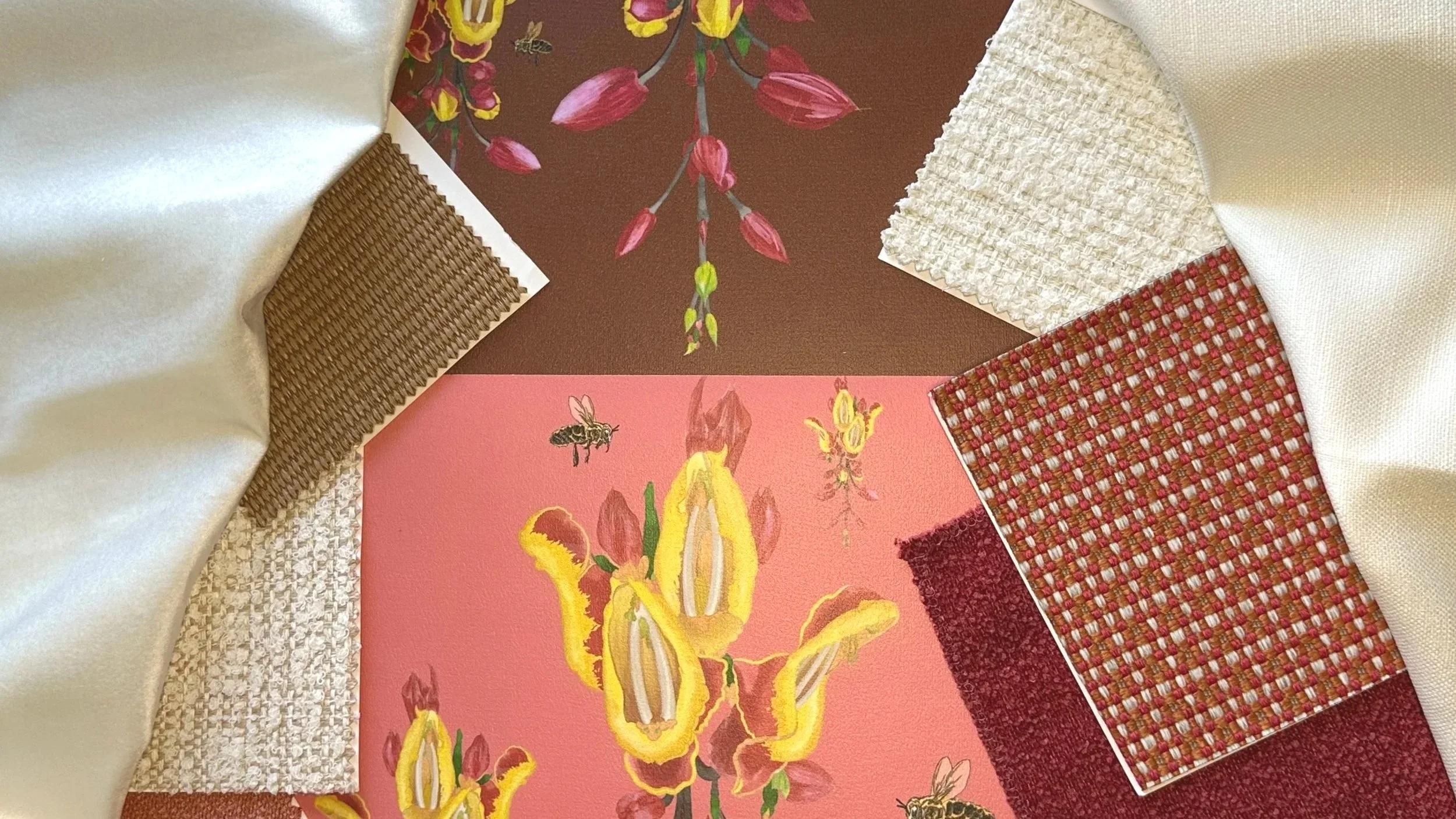
My signature fabric and wallpaper boards are intentionally free-form, not rigid grids. You might see:
A key wallpaper or fabric piece as the anchor.
Paint chips, wood and stone samples, and metal finishes layered around it.
Additional fabrics and textures overlapping and nested, the way they will actually layer in real life.
Rather than 2D or 3D renderings, I lean on:
Imagery and visual references to pinpoint the desired color palette, mood, and texture.
Real samples—fabrics, wallpapers, and finishes—you can touch and see in changing light.
Alongside this, I provide a preliminary budget or investment range. The aim is to:
Align on a collective, cohesive vision of how the space should feel and function.
Confirm that the proposed plan fits within the budget of those using the space—or identify where we need creative work-arounds to respect a firm cap.
This stage is about expectation-setting: making sure everyone is seeing the same “finished room” in their minds and understanding the level of investment required to get there.
Step 5: Ordering & logistics – the invisible, unglamorous 80%
This is the part those investing in the project don’t see but absolutely benefit from. Once the plan is approved (usually with a defined number of revisions), a decorator will often:
Finalize measurements for upholstery, window treatments, and custom pieces.
Place orders, track lead times, and coordinate deliveries.
Communicate with workrooms, upholsterers, wallpaper installers, and other trades.
Troubleshoot inevitable hiccups: damaged items, backorders, delays, substitutions.
When you get an email that says, “We’ve had a delay, and here’s how we’re handling it,” that’s your decorator doing quiet, behind-the-scenes work on your behalf. This is why decorators often ask you to sign off on a plan and then give them some room to manage the moving pieces.
Step 6: Installation & styling – where it all comes together
This is the moment most people imagine when they think about decorating—the “after” view. By the time installation happens, though, hundreds of decisions have already been made.
On install day(s), a decorator may:
Arrange furniture according to the agreed plan, with small tweaks for real-world scale and comfort.
Place rugs, hang window treatments, style surfaces, and hang art.
Layer in pillows, throws, books, and personal objects so the room feels lived-in and intentional.
Depending on the structure of the project and my relationship with the interior designer, I may be:
On site to handle the final decorative layer myself, or
Handing off detailed boards, notes, and guidance so the designer’s team can execute the install and styling under the shared vision we’ve created.
For projects outside my home base, being present for installation typically requires separate travel arrangements and accommodations. Some projects absolutely warrant bringing me in for that last 10%, while others are better served by my providing a clear decorative roadmap that the local team implements.
In either case, the goal is the same: to ensure the space not only looks complete, but also feels intuitive and welcoming to those using it every day.
Step 7: Aftercare – living with the design
A good decorator’s work doesn’t always end the moment the last pillow is fluffed. Often, there is:
A follow-up visit, call, or email once those using the space have lived with it for a bit.
Guidance on care: how to clean fabrics, maintain finishes, and protect upholstery.
Suggestions for “phase two” adjustments if needs evolve (for example, adding more storage or swapping a piece that turned out to be too precious for daily use).
This is also where decorators learn a lot:
What’s working brilliantly.
What small refinements could make the space even more supportive.
That feedback informs future projects and deepens the relationship.
Why decorators ask what they ask (and say what they say)
Throughout all of these phases, you’ll notice certain patterns in what a decorator asks and recommends. For example:
“Do we really need a performance fabric here?”
“Let’s reduce the number of options; it’s getting muddy.”
“What’s gravitating you to that layout?”
Far from being arbitrary, these moments are usually shorthand for:
“I’ve seen this go badly when we don’t make this choice.”
“Too many options will derail clarity and make this harder on you.”
“Do you feel that this layout will function the way you’ve told me it needs to if we take that approach?”
The questions are there to understand those using the space.
The recommendations are there to protect comfort, budget, and the long-term feel of the room.
When you understand that, it’s easier to hear a strong “I recommend…” or “I don’t recommend…” as a form of care, not control.
If you’ve been curious about what it’s really like to work with an interior decorator—from first conversation to final cushion—I’d be glad to walk you through the process for your own home or business. You can reach out to me to start a conversation about how we might partner on your next project.
If you’re an interior designer or decorator and want a simple way to explain this process to those hiring you, you’re welcome to share or adapt this framework as part of your own onboarding.
Subscribe to Surface & Space for new articles in your inbox and instant access to two free printable substrate guides (wallpaper & fabric), plus a bonus PDF on Conscious Creators of Gentle Textiles.
© 2025-2026 Gabrielle Hewson. All rights reserved. You’re welcome to share links to this article, but please don’t copy or republish the text or images without my written permission. For licensing, permissions, or any other use beyond linking, please contact me directly.