Playrooms, Bunk Rooms, and Shared Bedrooms: Where Performance Matters Most
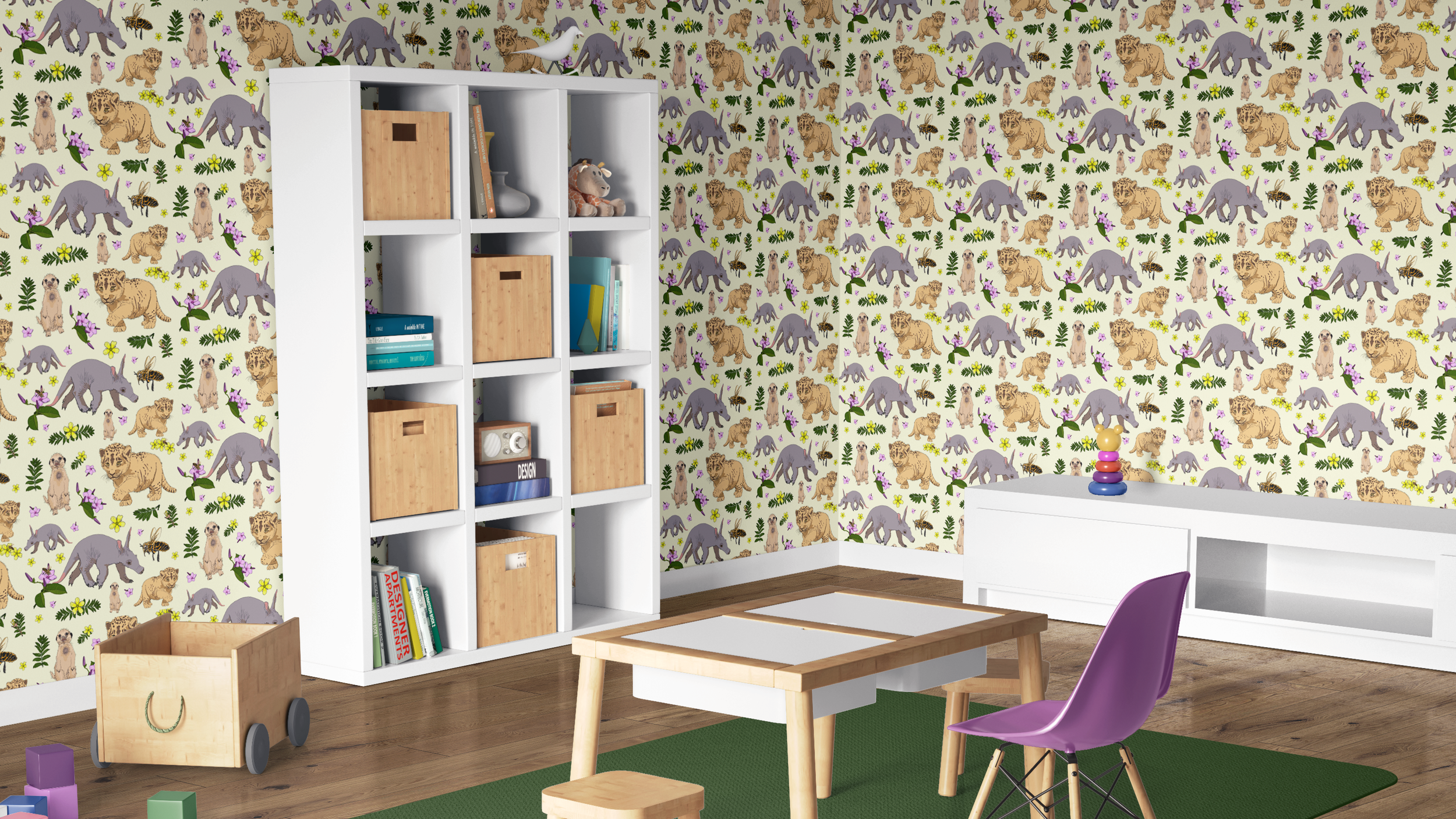
Spaces like the playroom side of a bedroom ask a great deal of their surfaces. Wallpaper helps bring pattern, energy, and cohesion, while the right substrate choice helps the room stand up more beautifully to the real wear of daily family life. Featured Serengeti - African Baby Animals (SABA-02 Pale Yellow)
Why these rooms deserve more thought than they usually get
Some of the hardest-working rooms in a home are also the ones families are most tempted to treat casually. Playrooms, bunk rooms, and shared children’s bedrooms are often approached as if they are temporary, secondary, or simply practical spaces—rooms to get through rather than rooms to really design.
I think that is a mistake.
These rooms often carry a tremendous amount of daily life. They are spaces for sleep, play, storage, reading, mess, movement, conflict, imagination, rest, and growth. They are touched, bumped, climbed on, leaned against, spilled on, and lived in hard. That means every material choice in them matters more, not less.
And because of that, these are some of the rooms where wallpaper and performance fabrics can be most valuable. Not as decorative extras, but as practical, beautiful tools for making the room feel stronger, more joyful, and easier to live with over time.
These are exactly the spaces where durability earns its keep
A formal sitting room may look lovely and stay relatively untouched. A playroom will not. A shared bedroom will not. A bunk room certainly will not.
These are the places where walls and soft elements are constantly in conversation with real bodies, real routines, and real energy.
That is why I think it makes so much sense to use surfaces that can actually support the life of the room. A durable wallcovering matters here not just because it looks good, but because it can help the room stand up to repeated wear with more grace.
That means thinking seriously about durability, ease of cleaning, a more forgiving surface for active daily use, and the ability to hold visual beauty while standing up to wear
That is not just convenient. It changes the design equation. It allows families to create a room that feels special without worrying that it will immediately become fragile or high-maintenance.
Paint is not always the practical winner families assume it is
Paint still carries the reputation of being the practical answer. It feels safe, familiar, and straightforward, especially in rooms where children are involved.
But many families know from experience that painted walls in high-use rooms do not stay looking fresh for long. Paint scuffs. It chips. Touch-ups can stand out. And once a room has been banged around for a few years, what felt like the easier solution can start asking for more maintenance than expected.
That is why I think the paint-versus-wallpaper conversation needs to be framed differently. This is not really about which one feels simpler today. It is much more about which one is likely to support the room better over time.
Wallpaper is usually the higher up-front investment. Paint is usually cheaper at the beginning. But in these kinds of rooms, I do not think the beginning tells the whole story. A durable wallcovering can bring stronger atmosphere, better day-to-day forgiveness, and a surface that may not ask to be redone nearly as quickly.
Pattern can hide the life of the room more gracefully
This is one of the quietest but most useful benefits of wallpaper in active family rooms. Pattern does not make minor imperfections disappear, but it often helps the room absorb everyday wear more gracefully than a flat painted wall does.
In a playroom, bunk room, or shared bedroom, that matters. These are exactly the rooms where dents, dings, scuffs, bumps, and visual wear are most likely to happen. A wallcovering with movement and pattern can often soften that reality more successfully than a large field of uninterrupted color.
That is one of the reasons wallpaper can continue to feel attractive longer in spaces that are used hard.
These are the spaces where substrate choice matters most
This is one of the articles where I think the substrate conversation matters most. In rooms like these, I do not think “wallpaper” is a specific enough answer.
For many active family spaces, I still think PVC-free Type II Non-pasted vinyl alternative is the strongest all-around lead recommendation. It gives a very good balance of durability, practical cleanability, and a more refined feel than many families expect from a harder-working wallcovering. This is often where I begin when the room needs to perform, but the family still wants an elevated, carefully considered interior.
That said, this is also the category where Non-pasted becomes especially compelling. When I want a durable, more paper-like wallcovering that can still handle hard-working residential life beautifully, it is a very strong option. In playrooms especially, and in other active family spaces where the walls are likely to see a lot of everyday use, Non-pasted can make a great deal of sense.
And then there is Vinyl, which becomes more relevant the rougher the room is going to be on its surfaces. In a bunk room used by multiple children, or a recreation-heavy room where maximum toughness, moisture tolerance, and easiest practical cleaning matter most, Vinyl can absolutely be the smartest choice.
So this is one of the places where I would be least likely to talk about wallpaper as one generic material. In spaces like these, the substrate is part of the design intelligence.
Prep matters either way
I also think it is important to say clearly that neither option is prep-free. Repainting properly still requires real preparation. Wallpaper does too.
And while the stronger wallpaper substrates I work with can tolerate more than delicate papers, I still recommend the smoothest wall possible. Smoother walls generally support better adhesion, a cleaner finish, a longer-lasting installation, and easier future removal.
That matters in rooms like these, because if a family is making a more substantial surface decision, it should be one that installs well, lives well, and can eventually transition well too.
Timing matters too
Because wallpaper is a printed material, I always recommend sampling reasonably close to the final purchase and then ordering within a week or two once the decision is made. That helps keep the final installation aligned with the approved sample and reduces the chance of print-run variation becoming part of the story.
In high-use family spaces, where the wallpaper is often meant to carry the room for years, that kind of timing is part of doing the project well.
These rooms need emotional energy too—not just practicality
Practicality matters in playrooms, bunk rooms, and shared bedrooms, but I never think that should come at the expense of joy. These rooms are often some of the most emotionally active in the home. They should support imagination, ease, belonging, comfort, and fun.
Wallpaper is one of the fastest ways to set that tone. It can make a room feel: brighter, more inviting, more imaginative, more playful, more layered, more memorable.
And because these rooms are often used heavily, that emotional lift really matters. A room that feels designed with care is often a room families want to care for more in return.
That does not mean the room must be visually loud. It simply means the room should feel like more than an afterthought.
Shared rooms especially benefit from a strong visual framework
Shared bedrooms and bunk rooms often have to do more than a single-child room. They may need to hold more than one personality, more than one rhythm, and more than one set of belongings. That is a lot for a room to carry.
One of the reasons wallpaper can be so helpful in these spaces is that it gives the room a stronger visual foundation. Instead of relying on every smaller object to create charm or cohesion, the walls can establish a clear sense of atmosphere from the start.
That can be especially helpful when:
two children are sharing one room
a bunk room needs to feel cohesive despite multiple beds
the furniture arrangement is dense
the room needs a sense of order without feeling stiff
A patterned wallcovering can become the thing that quietly holds everything together.
Playrooms are where the strongest practical case comes into focus
If there is one room type where I think the practical case for wallpaper becomes especially obvious, it is the playroom.
Playrooms are often full of: movement, contact, objects constantly being shifted, visual stimulation, mess, storage challenges, and/or furniture that gets moved around.
In a room like that, I want the surfaces to work hard. I also want the room to feel cheerful and inspiring. A durable, easy-to-clean wallcovering lets both of those things happen at once.
And because playrooms often evolve over time—sometimes becoming study spaces, hangout spaces, media rooms, or multi-use family rooms—it helps to have a wall treatment that brings enough visual character to stay relevant as the room matures.
This is also the room where I think Non-pasted and Vinyl often deserve more airtime than they might in a nursery. PVC-free Type II Non-pasted vinyl alternative still makes a great deal of sense, but in the hardest-working versions of these rooms, I want to be very honest about whether the space needs the especially strong residential durability of Non-pasted or the extra toughness of Vinyl.
Why performance fabrics belong in the same conversation
These rooms are never just about the walls. The fabric choices matter just as much.
Because I work across both wallpaper and fabric, I can help create rooms where the wallcovering, bedding, drapery, and other soft elements feel intentionally connected from the beginning rather than pieced together afterward.
In spaces like these, I am often thinking about: window seats, benches, floor cushions, banquettes, reading nooks, headboards, Roman shades, drapery, pillows, bedding, occasional upholstered chairs.
All of those elements need to feel good, yes—but in these rooms, they also need to perform. That is why performance fabrics are such an important part of the larger conversation.
A strong room is not built from one practical choice and several fragile ones. It is built from materials that understand the room’s real life.
Performance fabrics can help these spaces feel softer and more layered without sacrificing durability. They make it much easier to create a room that feels elevated and complete while still being entirely believable for the way it will be used.
What this can look like in real life
A playroom with a cheerful, pattern-rich wallcovering, paired with a built-in bench cushion in performance fabric and a few pillows that add softness without feeling precious.
A bunk room where the wallpaper gives the room a strong visual framework, while the bedding and window treatments provide color shifts and flexibility as the room evolves.
A shared bedroom where the wallcovering brings cohesion and atmosphere, and the upholstery and pillows provide comfort and personality without crossing into visual chaos.
These are the kinds of rooms that prove practical does not have to mean plain.
For decorators and designers: why this is worth leading with
If you are guiding a family project, I think these spaces are some of the strongest places to make the case for wallpaper and performance fabrics early.
Because the rooms work so hard, the argument is not abstract. You can talk clearly about: durability, ease of cleaning, longer-term flexibility, a stronger emotional atmosphere, a room that looks more considered and stays useful longer.
But I also think substrate specificity matters here. The conversation should not just be “Would you like wallpaper here?” It should be:
Which wallcovering best matches this room’s actual level of use?
Do we want the more refined all-around balance of PVC-free Type II Non-pasted vinyl alternative?
The hard-working, more paper-like strength of Non-pasted?
Or the maximum toughness and easiest practical cleaning of Vinyl?
That is a much stronger position than talking about wallpaper as one generic product.
For families: what to consider
If you are shaping one of these rooms in your own home, I would encourage you to think about more than what looks fun at the moment. Also ask:
What will hold up well here?
What will still feel uplifting after daily use sets in?
What surfaces will make this room easier to live with, not harder?
What atmosphere do I want this room to create for the people using it most?
Which substrate best matches how hard this room is really going to be used?
What choice feels strongest not just for right now, but for the years we hope this room will carry a lot of life?
These rooms may be active, noisy, messy, and constantly changing. That is exactly why they deserve thoughtful materials.
The rooms that work hardest should not be the least designed
That is really the heart of it.
Playrooms, bunk rooms, and shared bedrooms should not be reduced to utility simply because they are active. In many homes, they are some of the richest spaces for personality, imagination, and daily memory-making. Those rooms deserve walls that can hold up. They deserve fabrics that can support real use. They deserve pattern and color that make the room feel alive. And they deserve design choices that make the room easier to live with, not just easier to install.
That is why I think these are exactly the spaces where performance matters most—and why thoughtful wallpaper and fabric choices can make such a lasting difference.
If you’re an interior decorator or interior designer and want a pattern-focused partner to help you create children’s and family spaces that feel joyful, durable, and beautifully considered, I’d love to collaborate.
If you’re reading this as someone shaping your own home and want a playroom, bunk room, or shared bedroom that feels imaginative, hard-working, and genuinely pleasant to live with, you can contact me to engage my interior decorating services.
And if this kind of discussion is helpful, you can:
Subscribe to Surface & Space to have new posts land in your inbox on Fridays.
Access a growing library of subscriber-only PDF guides that make decisions about wallpaper, fabrics, and substrates feel more grounded and informed.
© 2025-2026 Gabrielle Hewson. All rights reserved. You’re welcome to share links to this article, but please don’t copy or republish the text or images without my written permission. For licensing, permissions, or any other use beyond linking, please contact me directly.