Telling a Better Story: How Pattern + Fabric Shape the Personality of a Home or Business
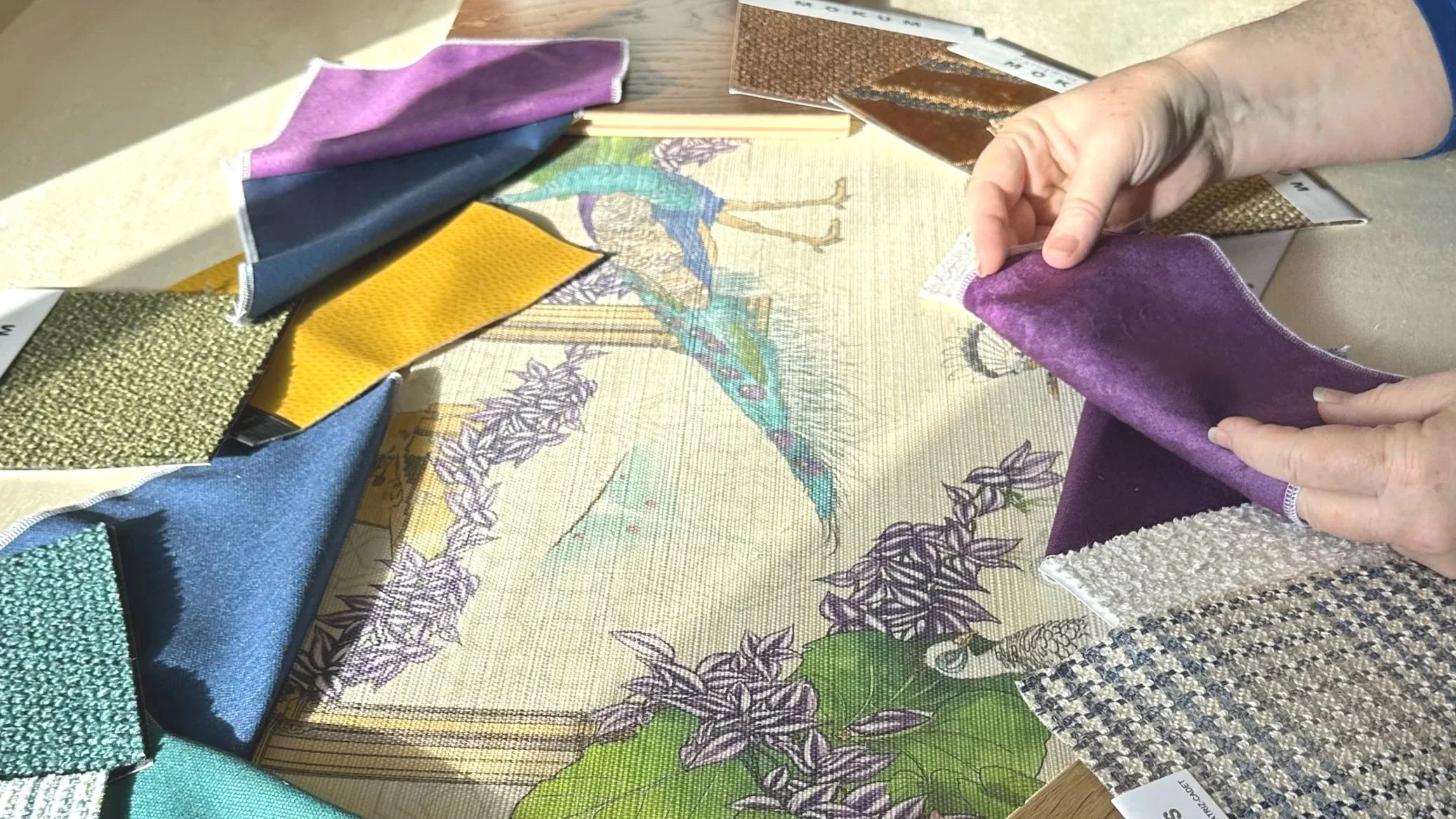
Pattern and fabric do far more than decorate a room—they shape the personality of a home or brand. Explore how wallpaper, textiles, and repetition can be used to tell a clearer story in residential and commercial spaces.
From “pretty” to purposeful: treating pattern as narrative, not just decoration — The story your space tells before you ever speak
When someone steps into a home, studio, shop, even hotel foyer, they’re reading the room in seconds. Before they notice the art or the styling details, they’re registering the rhythm (pattern), softness (textiles), and color story. Together, those elements quietly answer questions like:
Is this space relaxed or formal?
Is the brand approachable or exclusive?
Is this home playful, romantic, minimal, or layered and eclectic?
Pattern and fabric are some of the first things to answer those questions. A delicate botanical on wallpaper, a structured stripe on a bench, a textured bouclé on a chair—each one says something different about the personality of the space and the people (or brand) behind it.
“When we treat pattern as language instead of “extra,” we start to write much clearer stories”
How pattern gives a home its “voice”
Think of pattern as the tone of voice for a home. Two projects might share the same floor plan and even similar furniture, but if one uses a soft, hand-drawn floral and the other uses a sharp, graphic geometric, they’ll feel like completely different characters.
A few ways pattern shapes that “voice”:
Organic vs. structured
Organic, botanical, or hand-drawn motifs feel more conversational, human, and relaxed.
Geometric, linear, or repeat-precise patterns lean more tailored, modern, or disciplined.
Scale and density
Larger, more open repeats feel generous, airy, and confident.
Smaller, tighter repeats feel intimate, cozy, and sometimes nostalgic.
Contrast and color
High-contrast patterns read as energetic, bold, and opinionated.
Low-contrast, tonal patterns whisper rather than shout—perfect for quietly layered, calm spaces.
When these choices are aligned with who the end-user actually is—an introvert who loves ritual, a family who hosts every weekend, a couple who collects art—the pattern story starts to feel inevitable rather than random.
Fabric as character development: texture, comfort, and lived-in details
“If pattern is voice, fabric is character development.”
The textiles specified don’t just carry color and print; they tell the story of how this character(s) lives.
Linen and linen-blend textures hint at ease, sunlight, and a slightly rumpled elegance.
Velvets and chenilles suggest evening, drama, and a more cocooned, sensorial environment.
Cotton and performance weaves often read as approachable, hardworking, and “everyday polished.”
In a home, pairing a lively wallpaper with a soft, slubby linen on upholstery might tell the story of a relaxed, creative household. In a brand space—like a studio or small showroom—pairing a disciplined stripe with a structured wool blend sends a message of precision and professionalism — or vice versa, depending on the desired feeling the homeowner or business owner desires.
The key is consistency: when pattern and fabric are aligned with each other and with the person(s) or brand, they and their visitors feel that alignment long before they can articulate it.
“Pattern and fabric are the narrators of self-expression.”
Translating brand values into pattern + fabric
When working with brands—boutiques, creative studios, wellness spaces, hospitality—pattern and fabric can literally turn brand values into something you can sit on, touch, and stand next to.
For a brand, this might be: warm, refined, imaginative. For a home: grounded, joyful, collected over time, or, again, vice versa. Today’s brands are becoming less corporate and rigid, and more personal and relaxed.
Pattern behaviors serve to match traits:
Warm: rounded motifs, hand-drawn lines, fewer harsh angles.
Refined: controlled repeats, balanced negative space, disciplined color palette.
Imaginative: a touch of unexpected scale, a slightly offbeat color pairing, or one “surprise” pattern placement.
Pairing these patterns with the right fabric substrates that embody those traits ties the story together:
Warmth in fabric might be a brushed cotton, bouclé, or textured weave.
Refinement might be a performance linen, tight weave, or micro-pattern (a very small, subtle design woven or printed into fabric that's barely noticeable from afar but reveals texture and detail up close).
Imagination could be expressed through a bold statement piece of furniture in a signature print.
Subtle repetition locks the story in: Once the hero pattern has been identified along with a couple of supporting fabrics, repeating them with intent: the same motif on a cushion and a bench; the same stripe echoed in a window treatment is what makes the story stick.
The cohesion is palpable. That’s what turns “cute office makeover” into “this space feels exactly like me, us, or our brand.”
For homes: using pattern to express personality without visual noise
Homeowners often say they want their space to “feel like us”—but they’re not sure how to get there without it becoming chaotic. Pattern and fabric provide a very controllable way to layer personality.
Some practical ways I do this:
Using one narrative per room — Maybe the narrative is “quiet coastal” or “Parisian-inspired eclectic”. Flowing organic motifs vs. smart stripes, chalky blues vs. deep, dark red color with brown undertones in pattern and fabric reinforce this.
Building a pattern hierarchy — Give each room:
1 hero pattern (wallpaper or a statement fabric),
1–2 supporting patterns (smaller scale or lower contrast), and
plenty of solids with beautiful texture.
Threading a “signature” motif through the collective spaces — A repeated botanical, stripe, or geometric that shows up in smaller ways—on a cushion here, a shade there—creates a sense of continuity, like a recurring theme in a novel.
Using textiles to soften strong architecture — In homes with hard lines—lots of glazing, stone, or sharp transitions—patterned fabric on drapery, upholstery, and bedding can round off the mood and make the story more welcoming.
For commercial spaces: pattern and fabric can serve beautifully as a living brand guide
Commercial brand guidelines usually show typefaces, colors, and photography style. But, when decorating a branded space (office, studio, pop-up, or hospitality), it’s incredibly effective to think of pattern and fabric as an extension of that brand book without putting a logo on everything.
For example, what I call “corporate rigid” can be perceived as highly exclusionary and as if marking one’s territory with logos and high-contrast patterns and colors, stiff or plastic performance wallpapers and fabrics. However the following can loosen up and make inviting an otherwise inhibiting space.
A recurring motif — Maybe it’s an abstracted version of the logo, or a pattern inspired by the brand’s origin story. It can appear on a feature wall, on an upholstered bench, and in small detail moments like a notice board or cushion.
Textiles that reflect the brand promise — A wellness brand might lean into soft, natural fibers and organic motifs. A technology or creative agency might favor crisp geometrics, structured upholstery, and a tighter, more graphic palette.
Consistency across touchpoints — When the same pattern language shows up on a client welcome gift (like a notecard), a meeting room wall, and the reception seating, it reinforces brand recognition without feeling heavy-handed.
Seasonal or campaign-based layers — Keeping core upholstery and wall patterns consistent, then swapping out smaller textile accents—like cushions and throws—to reflect a launch or collection keeps the space feeling current while preserving the brand’s backbone.
Bringing others into the story
Whether I’m designing a home or a commercial space, part of the magic is helping others see themselves inside the story I’m creating for them with pattern and textile.
Naming the story out loud and connecting emotionally: letting a wallpaper do the storytelling at your entry—warm, collected, inviting from the first step in—helping others connect emotionally.
Showing how different pattern/fabric combinations tell slightly different versions of the same story: one more formal, one more relaxed, one more playful.
Inviting them to choose a ‘signature’ — “Which pattern feels most like you?” Then use that motif in a few key touchpoints so they feel truly seen in the design.
Enabling authorship invites co-authors of the story, and their attachment to the finished space becomes beautifully personal and meaningful.
If you’re ready for your home—or your brand space—to tell a clearer, more intentional story through pattern and fabric, I’d love to explore it with you. Whether you’re interested in full-service decorating, specifying wallpaper and textiles, or developing a custom pattern for your brand, you can reach out to me to start the conversation.
Curious how these patterns feel in person? You can easily request samples by clicking “Request A Sample” at the bottom of any collection page on my website. View my curated wallpaper and fabric collections.
Subscribe to Surface & Space for new articles in your inbox and instant access to two free printable substrate guides (wallpaper & fabric), plus a bonus PDF on Conscious Creators of Gentle Textiles.