The Life of an Interior Designer: The End-to-End Experience of Working With an Interior Designer and Why They Ask or Tell You What They Do
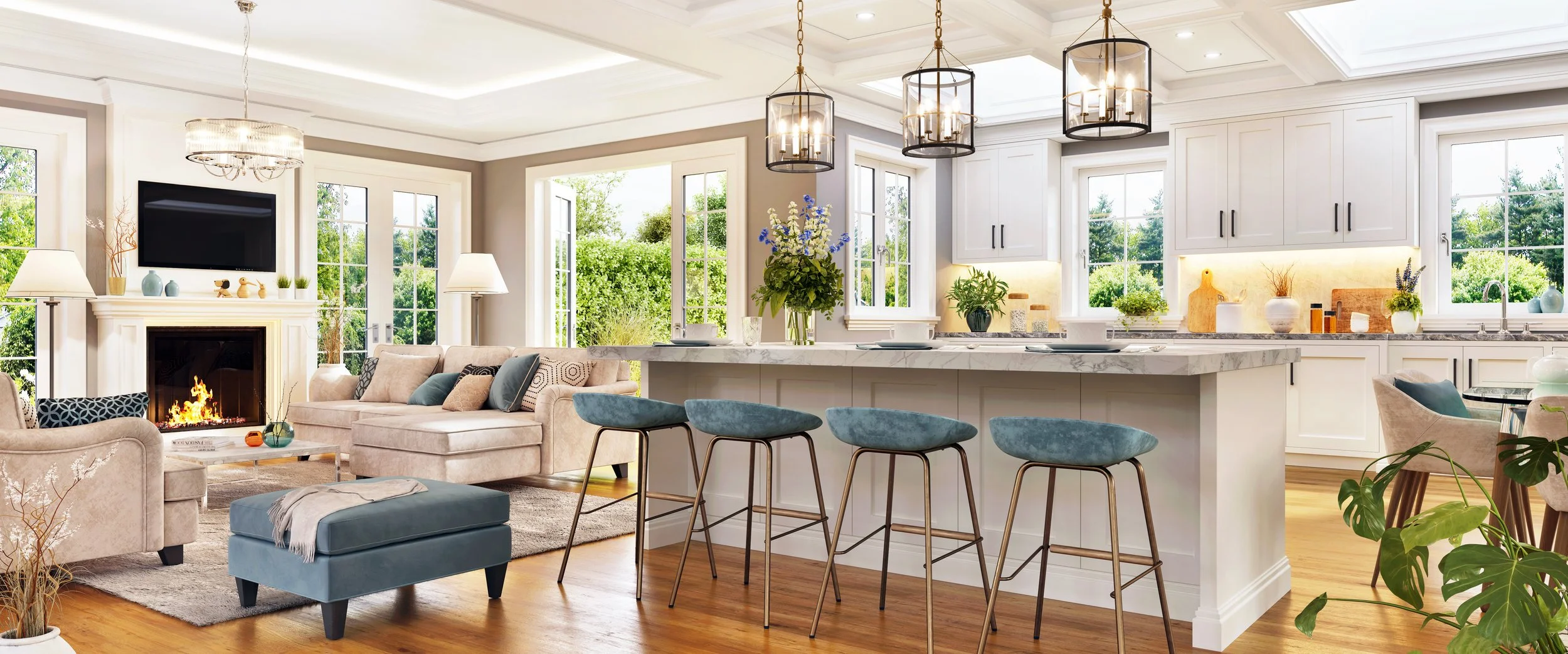
From the outside, it can look like an interior designer “just chooses finishes and furniture.” Inside the process, it’s hours of space planning, coordination with trades, technical drawings, code considerations, budgeting, and emotional support for those using the space. As exampled above, a well-designed home isn’t just a pretty room—it’s a sequence of spaces that work together, from kitchen to living room and everything in between. In this post, I’m walking through the typical end-to-end experience of working with an interior designer—what’s happening in each phase, and why designers ask or tell you what they do.
A quick note on my vantage point
I’m writing this from the perspective of someone who has been immersed in residential interiors for more than twenty years and now works professionally as an interior decorator and wallpaper & fabric pattern designer who regularly partners with interior designers. My background spans interiors, illustration, textile design, and decorating, which means I understand both the artistic and technical sides of pattern and how those choices translate into real spaces. When I’m collaborating with interior designers, I think the way they do about flow, function, and structure; when I’m decorating or designing patterns, I’m focused on how those using the space will actually live with every surface. It’s a fluid relationship that lets me support the full experience of a room—its bones, its personality, and the way it feels to be in, day after day.
Why this article exists (and who it’s for)
If you’re an interior designer, you already know your job is a blend of:
creative director
problem-solver
project manager
translator between trades and those using the space
You live with all of that complexity every day, even when what others see is just a beautifully finished room on install day.
If you’re reading this as a homeowner or business owner, you might only see snapshots: a presentation here, a paint sample there, a site visit where your designer says “no” to a light fixture you fell in love with online. It can feel mysterious—or occasionally frustrating—if you’re not sure why decisions are made in a certain order.
My hope is to bridge that gap a bit:
For designers: to feel seen and supported in your process.
For those hiring a designer: to understand what’s actually happening behind the scenes and why certain requests or boundaries come up.
I’m writing this as an interior decorator and wallpaper / fabric pattern designer who often collaborates with interior designers. I’m not here to tell designers how to do their jobs—this is meant as a clear, respectful translation of what many of you are already quietly doing.
Step 1: Discovery – getting to know the space and those who use it
Every thoughtful design project begins with listening.
On the surface, a discovery meeting might look like a friendly conversation and a walk-through. Underneath, the interior designer is gathering information that will ripple through every decision.
What typically happens
Initial conversation — You’ll talk about how spaces are used now, what’s working, and what absolutely isn’t. Interior designers listen for patterns: bottlenecks, frustrations, hopes, and non-negotiables.
Lifestyle and operations — For homes, this might be morning routines, pets, hobbies, and how many people need to move through a space at once. For businesses, it might be team flow, guest experience, brand expression, and maintenance realities.
Budget and timeline — Interior designers will ask about investment range and timing—not to limit ideas, but to shape what is realistic. This helps prevent heartbreak later.
Existing architecture and constraints — They’ll pay attention to structure, window placement, natural light, ceiling heights, and any fixed elements that must stay.
Why designers ask what they ask
Questions that can feel personal (“How do you really use this room?” “What investment level feels sustainable?”) are not idle curiosity. They’re a way of:
protecting those using the space from designs that look great on paper but fail in daily life
aligning expectations with what is realistically possible
honoring the fact that a beautiful space no one can maintain is not a success
If there’s one way to support this phase, it’s honesty. The more open the conversation is here, the more tailored and effective the design can be later.
Step 2: Concept & space planning – shaping the bones before the beauty
Once the interior designer understands the space and the people in it, they move into concept and planning.
What typically happens
Space planning — Interior designers sketch and draft layouts that address flow, clearances, sightlines, and functional zones. This is where they decide where walls might move, where new openings could go, and how furniture will sit in relation to windows, doors, and circulation paths.
Concept direction — Moodboards, inspiration imagery, and initial material ideas come together. This is less about specific pieces and more about how the space should feel.
Early technical considerations — Interior designers begin thinking about where lighting is needed, where plumbing might need to shift, and how built-ins or millwork might change the architecture.
Why designers sometimes say “no” in this phase
You might hear:
“That sectional you love is too large for the circulation we need here.”
“If we put the TV on that wall, we’ll be fighting glare all day.”
“We can’t push that wall as far as you’re imagining without affecting structure.”
It can be tempting to interpret these as roadblocks. In reality, they’re guardrails. Interior designers are:
protecting safety and function
preserving long-term comfort
preventing expensive fixes down the line
Once the bones feel right, the beauty is much easier to layer in.
Step 3: Design development – materials, finishes, and fixtures
This is the phase many people picture when they think of interior design: tiles, wallpapers, fabrics, fixtures, and colors.
What typically happens
Hard finishes — Interior designers select flooring, tile, countertops, plumbing fixtures, hardware, and millwork details. These decisions need to work together visually and stand up to real-life use.
Lighting — Locations, types (ambient, task, accent), and fixtures are chosen with both aesthetics and function in mind. This can involve lighting plans and coordination with electricians.
Color and materials story — A cohesive palette comes together. This is where wallpaper and fabric often enter the conversation, especially in collaboration with interior decorators and pattern designers.
Preliminary furniture direction — Even if furniture is finalized later, interior designers start thinking about scale, style, and arrangement so the architectural choices support what will eventually live in the space.
Why designers might “steer” choices
You may hear things like:
“This stone is beautiful, but it will etch and stain in your kitchen as you described using it.”
“This fabric won’t hold up on that everyday sofa—but it might be wonderful on a pillow or occasional chair.”
“This wallpaper is stunning, but in this particular room we’d be fighting the light all day.”
These are not simply aesthetic judgments; they’re a mix of material knowledge, lived experience, and advocacy for those using the space. Interior designers are constantly negotiating between what looks incredible in a sample and what will still feel right five years from now.
Step 4: Documentation, pricing, and coordination
This is one of the most invisible parts of an interior designer’s job, and one of the most important.
What typically happens
Drawings and documentation — Interior designers produce floor plans, elevations, lighting plans, and sometimes 3D visuals. These become the language contractors, cabinetmakers, and trades rely on.
Specifications and schedules — Every material, fixture, and finish needs to be documented: product names, finishes, sizes, quantities, installation notes.
Pricing and revisions — Contractors and vendors price the design. The interior designer then revisits the plan with those using the space to adjust scope or selections as needed to align with budget and timing.
Coordination with other professionals — Interior designers work closely with architects, engineers, builders, interior decorators, and trades to ensure everything fits together.
Why designers charge for this phase
From the outside, it may look like “just paperwork.” In reality, it’s where:
responsibility and liability are managed
misunderstandings are prevented
the vision is translated into instructions that dozens of people can follow
When interior designers ask to pause changes once documentation is complete, it’s often because even small shifts at this stage can ripple across drawings, orders, timelines, and pricing.
Step 5: Construction & implementation – when the plan meets the real world
This is where things get dusty. Interior designers move between their screens, the jobsite, and their inboxes more than ever.
What typically happens
Site visits — Interior designers visit the jobsite to check that walls, openings, and built-ins match the intent. They may catch issues early: a vanity height that needs adjusting, an outlet in the wrong place, a tile pattern that’s drifting.
Field decisions — Not everything is visible on paper. Interior designers are often asked quick questions by trades—“Where do you want this sconce centered exactly?”—that require them to make micro-choices to preserve the original concept.
Problem-solving — Products get discontinued, shipping delays happen, existing conditions surprise everyone. Interior designers recalibrate in real time to keep the project moving while preserving the space’s core feeling.
Why designers ask for fewer last-minute changes
During construction, you may feel a mix of excitement and anxiety—and new inspirations or products might catch your eye.
Interior designers know that:
changing a tile after it’s ordered can affect layout, grout, and schedule
swapping a light fixture can require new wiring, patching, and re-coordination
introducing new furniture dimensions mid-stream can throw off clearances and flow
When interior designers ask to log new ideas for future phases, they’re not shutting creativity down; they’re protecting everyone’s time, budget, and mental bandwidth.
Step 6: Installation & styling – the reveal (and the last 10–20%)
This is the part most visible in TV shows and social media: furniture arrives, rugs are placed, art is hung, styling pieces appear.
What typically happens
Furniture and rug install — Large items are placed first so the room’s physical structure is clear.
Accessories and art — Interior designers layer in books, objects, textiles, and artwork. This is where the story of those using the space really comes into focus.
Final adjustments — Chairs are nudged, lamps are moved, pillows are swapped. Small changes make a large difference.
Two things are almost always true here:
The room often looks worse before it looks better.
The last 10–20% of styling is what pulls everything together.
Why designers sometimes ask for a bit of distance
If those using the space are present during install, it can be disorienting to see boxes, tools, and half-arranged pieces.
When interior designers ask for:
a bit of space to finish
time to complete their styling pass before feedback
or a few days of “living with it” before making major changes
it’s usually because they know the room needs to be fully in place before anyone can fairly respond to it.
Small tweaks afterward are normal and expected. But the full picture needs to exist first.
Interior designers and interior decorators: different roles, shared goals
Every firm structures roles differently. Sometimes the interior designer also handles decorating and styling. Sometimes they collaborate with:
an interior decorator
a pattern designer
or other specialists who focus on textiles, wallpaper, and the emotional “finish” of the space
In collaborations I’m part of, interior designers often handle:
architectural changes
cabinetry and millwork
lighting and electrical plans
floor plans and built-in details
while I focus more on:
wallpaper and fabric pattern
how spaces feel visually and tactilely
color and pattern stories across rooms
and the finishing layers that support daily routines
It’s not about one role being “above” another. It’s about each of us working in the part of the process that lights us up, so those using the space get the benefit of deeply considered structure and deeply considered atmosphere.
If you’re an interior designer reading this
You’re likely doing most—or all—of this already. If anything here feels familiar, my hope is that you can point those hiring you to an article like this when you need:
a gentle way to set expectations
a reference for why your process has phases
language that helps explain why certain “no’s” are really long-term “yeses” for those using the space
I’d also love to be a collaborative resource when pattern and decorating layers need their own dedicated attention—so you can stay more focused on the architectural and technical pieces you do best.
If you’re someone hiring an interior designer
If you’ve made it this far, you’re already ahead of the curve.
A few ways to support the process and get the most from it:
Be as honest as you can in the discovery phase—about your routines, investment comfort, and what truly matters.
Share inspiration early, before drawings and documentation are finalized, so it can be woven into the plan instead of fighting it.
Trust the phases. There will be a time for big ideas, a time for tightening details, and a time to simply let the work unfold.
Remember that your interior designer’s questions and boundaries are almost always about protecting you and the long-term life of the space.
When that trust is there, the results tend to feel less like “someone decorated my room” and more like “someone translated how I want to live into walls, light, pattern, and furniture.”
If you’re an interior decorator or interior designer and want a textile-focused, pattern-obsessed partner to support your pattern-rich projects, I’d love to collaborate.
If you’re reading this as a homeowner or business owner and would like help building a fabric and wallpaper story that supports how those using your spaces live and work, you’re welcome to Contact Me to explore my interior decorating services.
And if this kind of conversation is helpful, you can:
Subscribe to Surface & Space to have new posts land in your inbox on Fridays.
Access a growing library of subscriber-only guides—covering wallpapers, fabrics, performance substrates, and other helpful tools to make decisions about pattern, color, and materials feel a little clearer.
© 2025-2026 Gabrielle Hewson. All rights reserved. You’re welcome to share links to this article, but please don’t copy or republish the text or images without my written permission. For licensing, permissions, or any other use beyond linking, please contact me directly.