Beyond Paint in Nurseries and Children’s Rooms: A Smarter Surface for Everyday Life
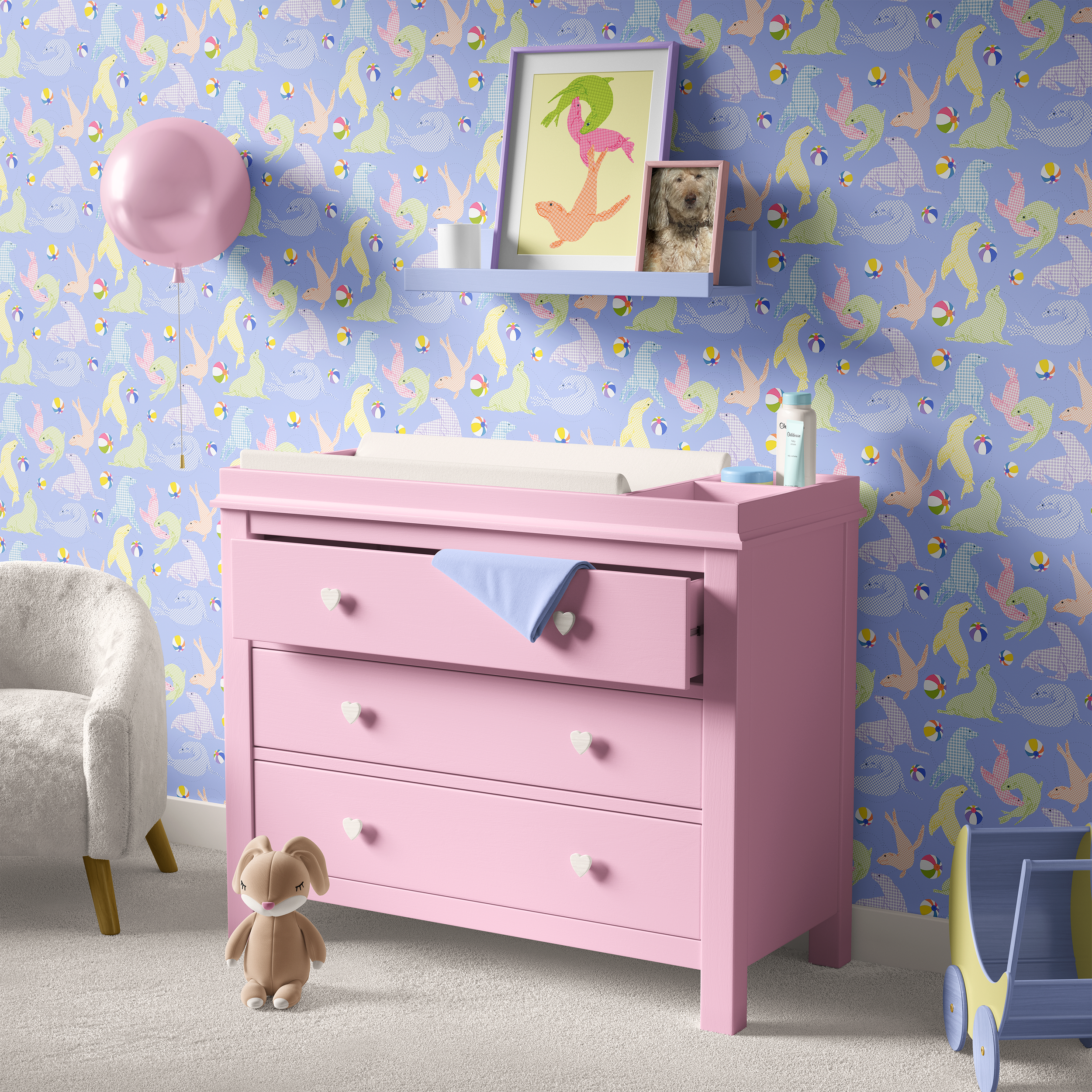
A child’s room can feel playful, layered, and deeply personal without needing to be redone every few years. Here, the wallpaper sets the room’s visual identity, while coordinated paint, bedding, and complementary fabrics pull colors from the pattern to create a space that feels cohesive now and flexible enough to evolve over time.

The playroom side of a bedroom is exactly the kind of space where surface decisions matter. Here, the wallpaper brings personality, movement, and joy, while the room’s storage, seating, and open play area show how a hard-working children’s space can still feel layered, cohesive, and inviting.
Why this conversation matters
When families are planning children’s rooms, paint is usually treated as the obvious practical choice. It feels familiar. It feels simple. It feels like the safe default.
And sometimes it is the right call. But I think paint is often over-trusted in spaces that are actually some of the hardest-working in the home. Nurseries, children’s bedrooms, playrooms, and children’s bathrooms are not gentle, static environments. They are rooms where life happens up close. Hands touch walls. Furniture bumps corners. Toys graze surfaces. Crayons appear. Time moves quickly.
So the better question is not just, What color should the room be? It is also, What surface is actually going to support the room well over time?
That is where I think wallpaper deserves far more attention than it usually gets. Not as a precious decorative extra, but as a serious surface choice for rooms that need to feel both joyful and resilient.
Why wallpaper can solve a different set of problems beautifully
Wallpaper approaches the room differently. Instead of relying on one flat color to carry the full weight of the walls, it introduces pattern, rhythm, movement, and visual texture. That matters practically as well as emotionally.
A patterned wallcovering can often:
• hide small imperfections more gracefully
• make minor scuffs and dings less obvious
• create a more finished feeling in the room
• bring a stronger sense of atmosphere and delight
• hold visual interest over time in a way a flat wall may not
That is one of the quiet advantages of wallpaper I do not think gets talked about enough. Pattern does not make life disappear, but it often helps the life of the room read more gracefully than a large expanse of uninterrupted painted color.
This is especially true in children’s spaces, where a little visual forgiveness can go a long way.
This is not just about durability. It is about what the room feels like.
One of the reasons I care so much about wallpaper in these spaces is that it changes the emotional quality of the room so quickly.
Paint can set color. Wallpaper can set atmosphere.
That may mean:
• a softer, calmer nursery
• a more imaginative bedroom
• a playroom that feels energizing but not chaotic
• a children’s bath that feels cheerful and memorable instead of purely utilitarian
Pattern can bring visual joy and a sense of story into the room. It can make the space feel held together rather than simply finished. And that matters, because the rooms children inhabit shape their daily experience in subtle ways.
A smarter surface can also be a longer-lasting one
Another reason I think wallcovering makes so much sense here is that it can help create rooms that do not need to be reinvented every few years.
A well-chosen wallpaper can:
• carry the personality of the room from one stage to the next
• feel age-flexible rather than theme-bound
• create a stronger visual identity without being childish
• allow softer elements to shift more easily over time
That means you can let the wallpaper do the heavier atmospheric lifting while changing out smaller things as needed—bedding, pillows, window treatments, artwork, or upholstered accents.
This is one of the reasons I often think wallpaper is the more flexible choice in the long run, even though it is sometimes treated as the more committed one.
Health belongs in this conversation too
Health matters in every room, but especially in spaces where babies and young children will sleep, play, and spend so many early hours.
For families in older homes, paint carries a concern that is bigger than scuffs or touch-ups. The Environmental Protection Agency (EPA) says deteriorating lead-based paint—peeling, chipping, cracking, damaged, or damp—is a hazard and needs prompt attention, especially in homes built before 1978.
That does not mean every painted nursery is unsafe. But it does mean wall surfaces deserve more thoughtful attention than they often get, especially in older homes.
On the new-materials side, many families also care about indoor-air considerations. UL Solutions (originally Underwriters Laboratories), the independent safety science company behind GREENGUARD certification, says GREENGUARD Gold certification reflects very low chemical emissions and is especially relevant in environments used by children, including homes, schools, and nurseries. The wallpapers I work with through my printer use GREENGUARD Gold certified water-based latex inks, which is one of the reasons families concerned about lower-emission interiors may find this conversation worth having.
So for families thinking carefully about what goes into a nursery, it makes sense to care not just about color and style, but about durability, ease of cleaning, and lower-emission material standards when those options are available.
And in newer design decisions, many families also care about what materials and finishes they are surrounding their children with. That is part of why lower-emission standards and more carefully chosen substrates matter.
Not every high-performing wallpaper is doing the same job
This is where I think it helps to be more specific. In children’s spaces, I do not think in terms of wallpaper versus paint alone. I also think about which wallpaper substrate best suits the room.
The three stronger substrates I work with each bring something useful to the conversation. PVC-free Type II Non-pasted vinyl alternative, traditional Non-pasted, and Vinyl are all performance-minded options, but they do not bring the same strengths in exactly the same way.
PVC-free Type II Non-pasted Vinyl Alternative Wallpaper
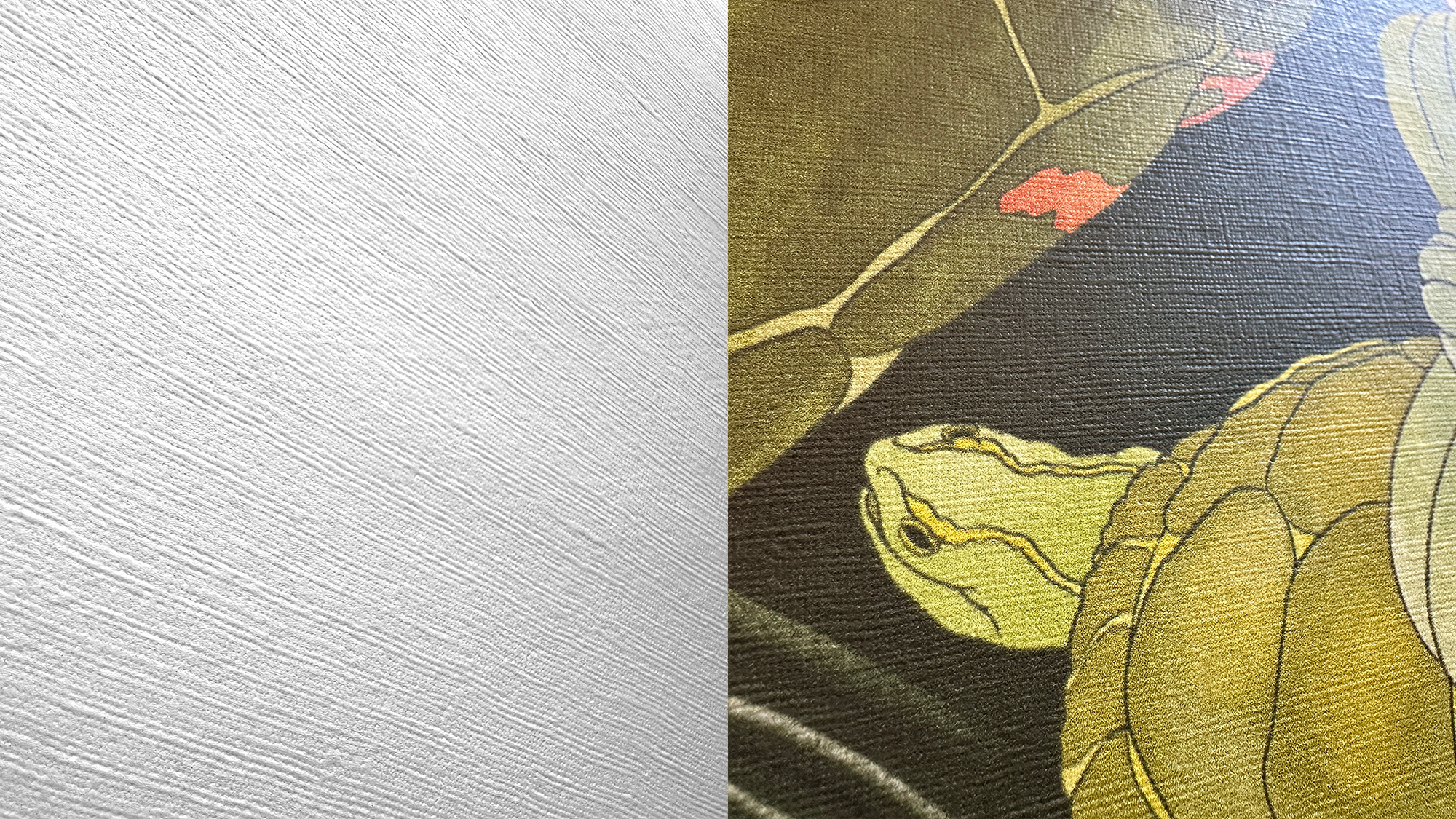
Extreme close-up of PVC-free Type II Non-pasted vinyl alternative base substrate alongside the intricacies of the Earth’s Sanctuary - Aqua Intima - Kame Nishiki (KZ-01 Deep Forest) printed on the same substrate. Note the graphite details of the design are still intact and still read as the organic hand-drawn artwork is came from.
For many children’s bedrooms and family spaces, I tend to lead with a PVC-free Type II Non-pasted vinyl alternative because it offers the balance I usually want most: durability, practical ease of cleaning, and a more refined finish. It gives families a stronger-performing wallcovering without pushing the room toward a more overtly utilitarian look.
Non-pasted Wallpaper
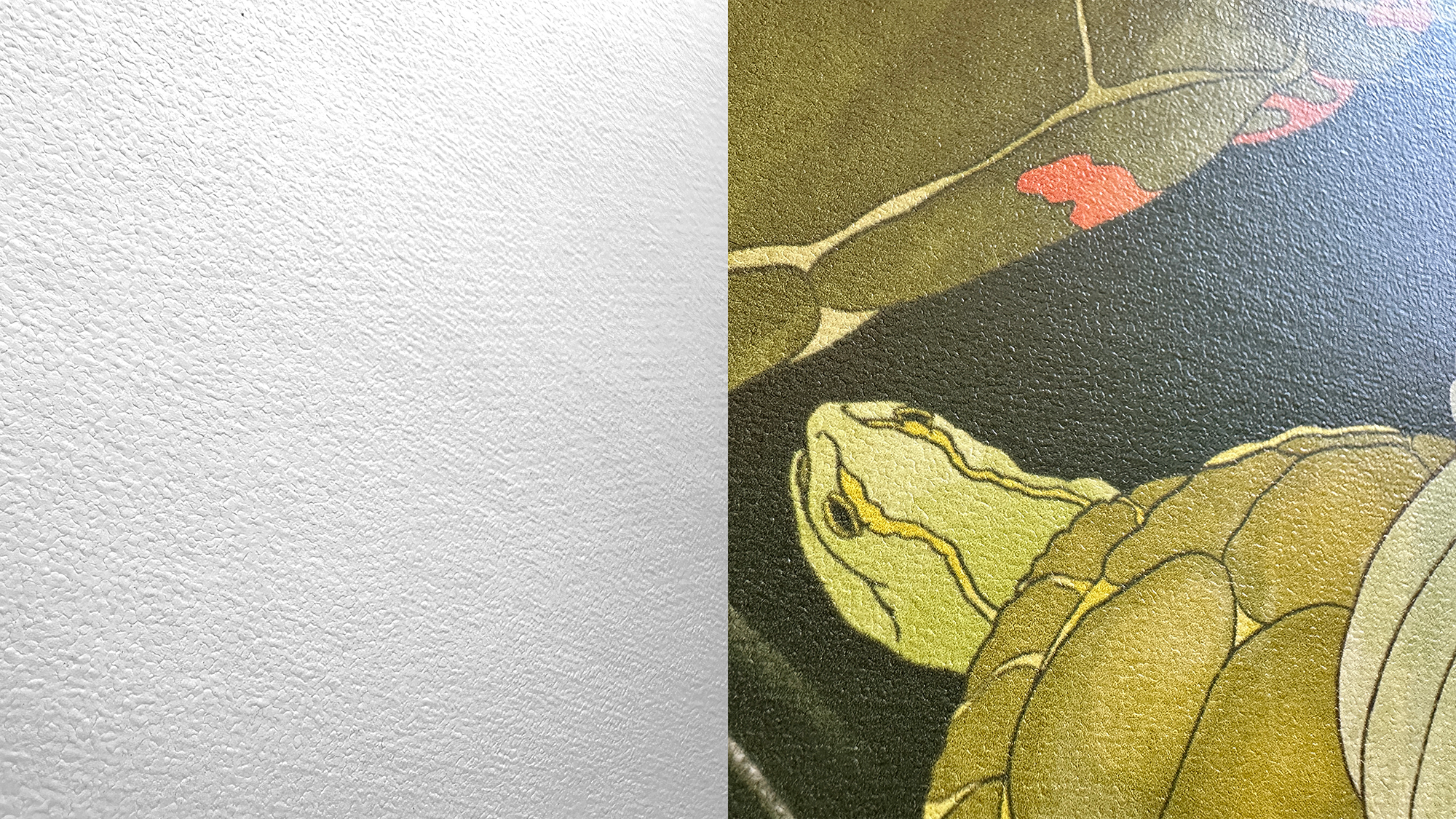
Extreme close-up of traditional Non-pasted base substrate alongside the intricacies of the Earth’s Sanctuary - Aqua Intima - Kame Nishiki (KZ-01 Deep Forest) printed on the same substrate. Again, note the graphite details of the design are still intact and still read as the organic hand-drawn artwork is came from.
Non-pasted is a strong option. I think of it as a durable, more paper-like, elegant choice that still works beautifully in real family life. It is especially compelling day-to-day, less hard-working spaces, but can also hold its own, keeping a softer, more traditional wallcovering character.
Vinyl Wallpaper
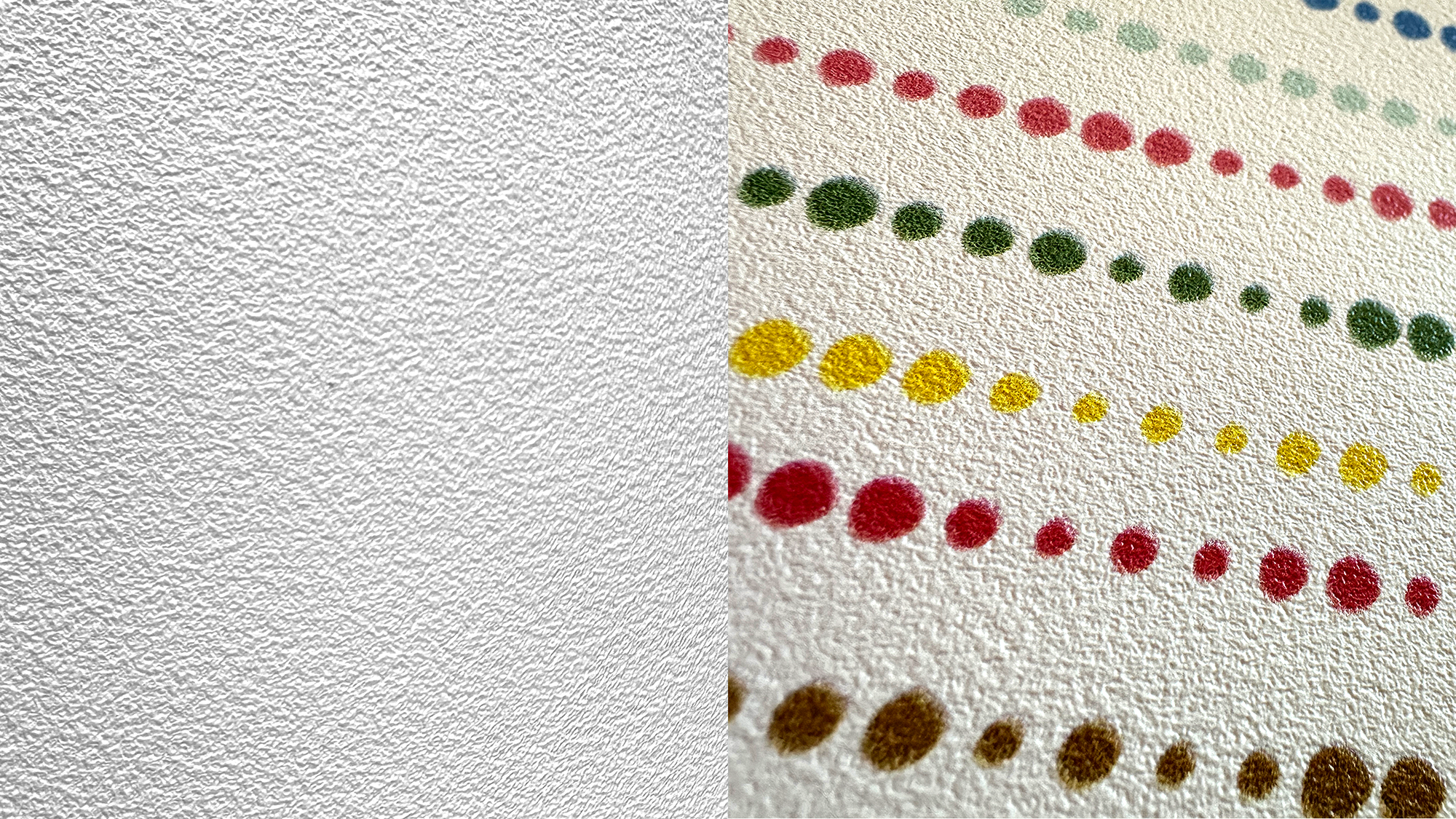
Extreme close-up of Vinyl base substrate alongside the Dotted Stripes, an organic geometrical design without fine lines (DS-CIPWD-01 Multi on White) printed on the same substrate. Note that the live substrate on the right is as white as the base and appears a bit warmer in my photograph.
And then there is Vinyl, which I tend to reserve for the toughest conditions. When moisture tolerance, repeated cleaning, and maximum practicality matter most, Vinyl can absolutely be the smartest answer. It is not the prettiest choice to my eye, but in the right room, its utilitarian strengths are exactly the point.
So while I often lead with PVC-free Type II Non-pasted vinyl alternative, I do not think the answer is one-size-fits-all. I think the smarter question is: What is this room really going to ask of the walls?
Why paint feels easier than it often is
Paint has the advantage of familiarity. Most families understand how it works. It is often presented as the lower-commitment, lower-stakes choice.
But in real life, painted walls in children’s spaces can become more maintenance-heavy than families expect. Paint can scuff. It can chip. It can show dings. Touch-ups often do not disappear seamlessly. Even when the color match is technically right, the finish or aging of the paint can make repaired spots stand out.
And once you are dealing with multiple rounds of touch-ups or repainting over the years, that supposedly simpler solution starts to become less simple.
This does not mean paint is bad. It simply means that familiar and best long-term choice are not always the same thing.
The cost conversation is real—but it is only the beginning of the story
If families are choosing between paint and wallpaper, cost has to be acknowledged honestly. Paint is usually the less expensive choice up front. Wallpaper is usually the higher initial investment.
That is true.
But in children’s rooms, I do not think the up-front number tells the whole story. These walls are more likely to be touched, bumped, scuffed, marked, and visually worn than walls in quieter parts of the home. That means repainting, patching, and touch-ups can become part of the room’s ongoing maintenance much sooner than expected.
Wallpaper asks for a bigger investment at the beginning, but it can also offer something paint often cannot: a more durable visual finish, a stronger emotional atmosphere, and a surface that may not ask to be redone nearly as quickly.
So for families building a home they intend to live in for years, I think the more useful question is not simply, What costs less right now? It is, What will make the room feel stronger, look better, and ask less of us over time?
Prep matters either way
One of the things that often gets overlooked in this debate is that neither option is truly effortless.
Repainting properly still requires prep. Walls may need patching, sanding, cleaning, priming, and a thoughtful application if the result is going to look good and last well.
Wallpaper requires prep too, and I think it is important to say that clearly. A properly installed wallcovering wants a well-prepared surface. And while the stronger wallpaper substrates I work with can tolerate more than delicate papers, I still recommend the smoothest wall possible. Smoother walls generally support better adhesion, a cleaner finish, a longer-lasting installation, and easier future removal.
So this is not really a conversation about “easy” versus “hard.” It is a conversation about which kind of investment makes more sense for the room.
Where performance fabrics come into the conversation
Wallpaper is only part of the story. If the room is being considered well, the fabrics matter just as much.
Children’s spaces often include:
• an upholstered chair or glider
• a bench
• Roman shades or drapery panels
• pillows
• a headboard
• bedding accents
• sometimes a small upholstered piece or reading nook
And all of those elements need to work in real life too.
This is why I think the strongest rooms come from considering wallcovering and performance fabrics together. A durable wall surface paired with impractical textiles leaves the room only half-resolved. But when the wallpaper and fabrics are both chosen with real use in mind, the room becomes much more holistic.
Performance fabrics can bring softness, comfort, and beauty while also helping the room hold up better over time. They are especially helpful when the room needs to feel elevated and inviting, but still be easy to live with.
A few places where this matters most
This way of thinking is especially useful in:
Nurseries — where parents and caregivers spend long stretches of time in the room and need beauty, calm, and practicality all at once.
Children’s bedrooms — where the room needs to feel personal and inspiring, but also age gracefully.
Playrooms — where wall surfaces often need to work hardest, PVC-free Type II Non-pasted vinyl alternative or Vinyl deserve especially serious consideration depending on traffic and wear.
Children’s bathrooms — where ease of cleaning matters and where wallpaper can add so much more life than paint alone.
Shared sibling rooms — where the room often needs a stronger visual framework to help it feel cohesive.
Each of these spaces benefits from choosing surfaces that are both emotionally thoughtful and physically appropriate.
For decorators and designers: how to frame this well
When you are presenting options for children’s spaces, I think it helps to move the conversation beyond “paint vs. wallpaper” as if one is decorative and the other is practical. That framing is too flat.
A more useful framing is:
• Which surface will best support the way this room will actually be used?
• Which substrate gives us the right balance of durability, ease of cleaning, and feel?
• Which one helps the room feel memorable instead of generic?
For many children’s rooms, that answer may be Non-pasted. In a playroom or another especially hard-working family space, PVC-free Type II non-pasted vinyl alternative or Vinyl makes more sense. That kind of nuance makes the recommendation feel smarter, not riskier.
For families: what to ask yourself
If you are shaping a child’s room of your own, I would encourage you to think beyond what feels easiest this week. Ask instead:
• What will still feel beautiful after real life starts happening here?
• What surface will be easier to live with over time?
• What kind of atmosphere do I want this room to hold?
• Do I want a room that simply looks finished, or one that feels genuinely special?
• Which substrate actually matches the way this room is going to be used?
The answer does not have to be wallpaper every time. But I do think wallpaper deserves to be considered much earlier in the process than it usually is.
Timing matters more than many families realize
Because wallpaper is printed material, I always recommend sampling reasonably close to the final order and then ordering within a week or two once the decision is made.
That timing helps protect both the design and the budget. Printing equipment is recalibrated regularly, so dye lots can shift between the sample in hand and the rolls that ship later. Ordering promptly makes it more likely that the rolls will stay aligned with the sample you used to make decisions about paint, furnishings, and other finishes.
That kind of timing does not make the project harder. It makes it smarter.
Children’s rooms can be practical and beautiful at the same time
I think that is really the heart of it.
These rooms do not need to be reduced to utility just because they belong to children. And they do not need to be fragile just because they are beautiful.
With the right wallcovering and the right supporting fabrics, children’s spaces can be:
• easy to live with
• full of personality
• more durable
• more uplifting
• more memorable
• and better able to support daily life with grace
That is not excess. That is thoughtful design.
If you’re an interior decorator or interior designer and want a pattern-focused partner to help you build children’s spaces that feel joyful, practical, and beautifully considered, I’d love to collaborate.
If you’re reading this as someone shaping your own home and want a child’s room that feels imaginative, durable, and genuinely pleasant to live with, you can contact me to engage my interior decorating services.
And if this kind of breakdown is useful, you can:
Subscribe to Surface & Space to have new posts land in your inbox on Fridays.
Access a growing library of subscriber-only resources—gentle guides to pattern, fabrics, and substrates you can return to whenever you’re making decisions.
© 2025-2026 Gabrielle Hewson. All rights reserved. You’re welcome to share links to this article, but please don’t copy or republish the text or images without my written permission. For licensing, permissions, or any other use beyond linking, please contact me directly.