Why Reupholstering Beloved Furniture Is More Luxurious Than Buying New
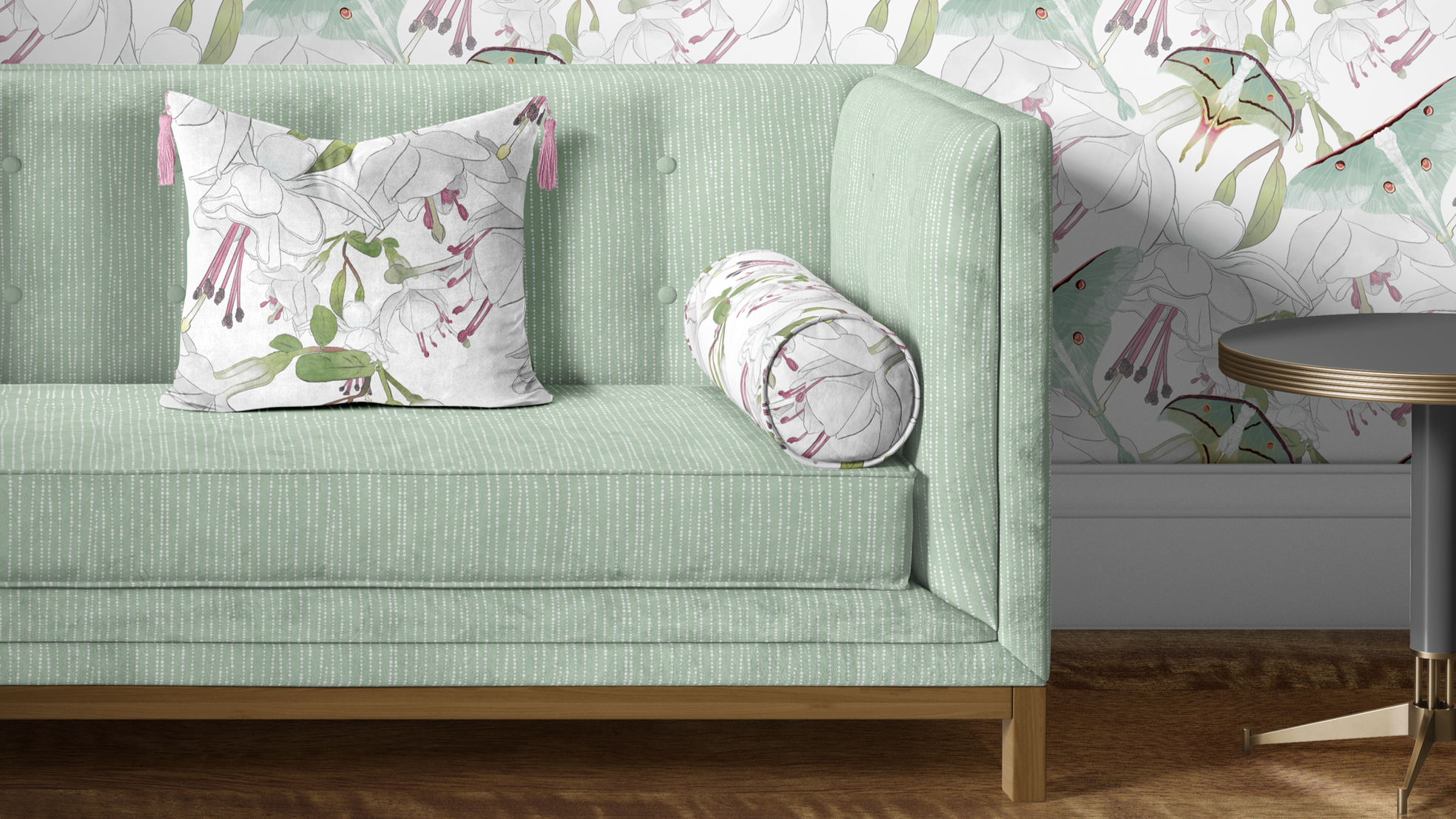
When we think “luxury,” it’s easy to jump straight to something brand new. ✨ But some of the most memorable rooms begin with a well-loved piece we choose to reupholster—then echo through custom pillows and wallpaper to tell a richer story. Collection: The Beauty of India; Patterns: Luna Moths & Fuchsia on White (wall), Just Fuchsia on White (pillows); and, Dotted Stripes - white on soft sage to match the color palette of the patterns used from this collection.
A Different Way to Think About “New”
Most of us have had that experience on a project walk-through: we’re mentally sketching the room, and then we notice a piece that clearly matters.
It might be a sofa that has followed someone through multiple homes.
A reading chair that’s become a bit threadbare.
An inherited piece with great bones and sentimental weight.
The default temptation—especially in a big transformation—is to replace. New furniture is simple to specify, and there’s no history to negotiate.
But often, those existing pieces are the very things that can make a finished room feel quietly luxurious. Reupholstery gives us a way to honor what’s already there, while still moving the design forward.
For any homeowners reading along: this is the part of the process you don’t always see, but it’s where a lot of the magic happens in collaboration with your designer.
The Hidden Strength in Well-Loved Pieces
When someone holds onto a piece for years, it’s rarely just because it “fills a space.” There’s usually another layer:
It’s genuinely comfortable.
It’s part of important memories.
It has a silhouette that still feels right, even if the fabric doesn’t.
Underneath faded or dated upholstery, many older or well-made pieces have:
Solid frames designed to last well beyond a single trend cycle
Joinery and proportions that hold up beautifully over time
Lines that are surprisingly adaptable once color and pattern are reconsidered
When we start by editing these pieces—rather than discarding them—we end up with rooms that feel more personal, less like a snapshot from a catalog.
Luxury as Story, Not Just Spend
There’s no question that new furniture has its place. But when we talk about luxury, we’re really talking about:
How a space feels to live in day after day
How clearly it reflects the people who use it
How intentionally everything relates, visually and emotionally
From that perspective, a reupholstered piece often carries more weight than something brand new.
A once-ordinary sofa, reimagined in a soft, textural stripe and layered with cushions and wallpaper in a favorite botanical print, doesn’t just “match the scheme.” It becomes part of the story of the room.
The luxury isn’t in the fact that it’s new. The luxury is in the care and attention it has received.
Reupholstery as Part of a Thoughtful Design Process
In practice, reupholstery works best when it’s folded into the overall design process, not treated as a separate, isolated task.
That might look like:
Noticing which existing pieces have genuine potential—structurally, proportionally, and emotionally.
Deciding the role each piece will play in the new version of the room: quiet anchor, pattern-forward focal point, or something in between.
Choosing textiles with the whole space in mind, so upholstery, wallpaper, window treatments, and rugs are all part of a cohesive conversation.
Using details—piping, banding, motif placement, skirt vs. leg—to echo other elements and create continuity.
The end result doesn’t read as “we kept that because we had to.” It reads as “of course this belongs here.”
Sustainability That Actually Feels Good
Many of us are thinking more about sustainability in our work, but it can sometimes feel abstract when we’re surrounded by so many product options.
Reupholstering a strong existing piece is one of the more tangible ways to design sustainably:
A solid frame stays in use instead of heading to a landfill.
We reduce the number of large items being manufactured and shipped for a single project.
We create rooms that don’t require a full reset every few years to feel current.
There’s also an emotional sustainability at play: there’s a particular kind of satisfaction when someone can say, “This piece has been with me for years, and I still love it.”
Investment, Not Just Replacement
It’s also fair to acknowledge the cost question. Sometimes reupholstery lives in the same range as purchasing a new piece, and that can raise eyebrows.
The way I think about it is this:
Replacement is often about solving a short-term problem: “We need a sofa that fits this wall.”
Reupholstery is about deepening something that already works: the comfort, the scale, the memories—while updating the surface so it supports the current design.
When the frame is good and the piece is genuinely used and loved, reupholstering is rarely about saving money. It’s about spending well—on something that will be appreciated and used for many more years.
When Reupholstery Makes Sense (and When It Doesn’t)
Not every piece deserves a second life, and that’s part of being honest in the process.
Reupholstery tends to make sense when:
The frame is solid and sits well.
The proportions still work with the architecture and layout.
The piece has some kind of emotional or aesthetic significance.
You can clearly see how it will fit into the broader story of the room once updated.
It’s often better to start fresh when:
The frame is unstable, poorly made, or uncomfortable in ways new cushions can’t fix.
The scale fights the room, even with fabric changes.
The piece is there by default, not by intention.
There’s no virtue in keeping something that actively works against the project. But when a piece has good bones and good reason to stay, reupholstery can be a beautiful way forward.
How Reupholstery Connects to Wallpaper and Fabric
For those of us working with pattern and surface design, reupholstery becomes an especially interesting tool.
Some of my favorite moments come from:
Using a quieter upholstery on a sofa and letting pillows and wallpaper carry a more expressive print.
Echoing a wallpaper motif in a more subtle way on a chair or bench cushion.
Carrying a color story across upholstery, wallcovering, and smaller textiles so the room feels layered without feeling busy.
In the image at the top of this post, the white Dotted Stripes pattern on soft sage, upholstered in one of my favorite bases—Performance Linen—sets the tone on the sofa. The botanical pillows from my Beauty of India: Just Fuchsia collection and the coordinating wallpaper from my Beauty of India: Luna Moths & Fuchsia collection are all speaking to each other. That’s not an accident; it’s the result of treating reupholstery as part of the larger composition.
If You’d Like to Explore This in Your Own Work
If you’re an interiors professional and you’re interested in weaving more reupholstery into your projects—especially alongside custom wallpaper and fabric—I love working in that space.
Together, we can:
Look at how existing pieces might be integrated into a new scheme rather than edited out.
Explore pairings between my wallpaper and fabric designs and the kinds of projects you’re taking on, and, when it makes sense, develop a custom pattern specifically for your client’s space.
Create palettes and pattern stories that support the kind of quiet, personal luxury you want your work to be known for.
For any homeowners reading along: these are the kinds of conversations you can have with your designer. If there’s a piece you’re attached to, it’s worth asking whether it might have another life in your next iteration of home.
And if you’re a homeowner just dipping your toes into the infinite possibilities:
Explore my wallpaper collections and fabric collections; samples can be purchased at the bottom of each collection page.
Inquire about design consultations or trade collaborations if you’d like support on a specific project or client brief.
And, if you’re not already working with an interior decorator or specialist, here are ways we might work together.
Subscribe to Surface & Space for new articles in your inbox and instant access to two free printable substrate guides (wallpaper & fabric), plus a bonus PDF on Conscious Creators of Gentle Textiles.
© 2025 Gabrielle Hewson. All rights reserved. You’re welcome to share links to this article, but please don’t copy or republish the text or images without my written permission. For licensing, permissions, or any other use beyond linking, please contact me directly.