Bringing the Outside In: How Nature-Inspired Patterns Bring Calm into High-Performance Spaces
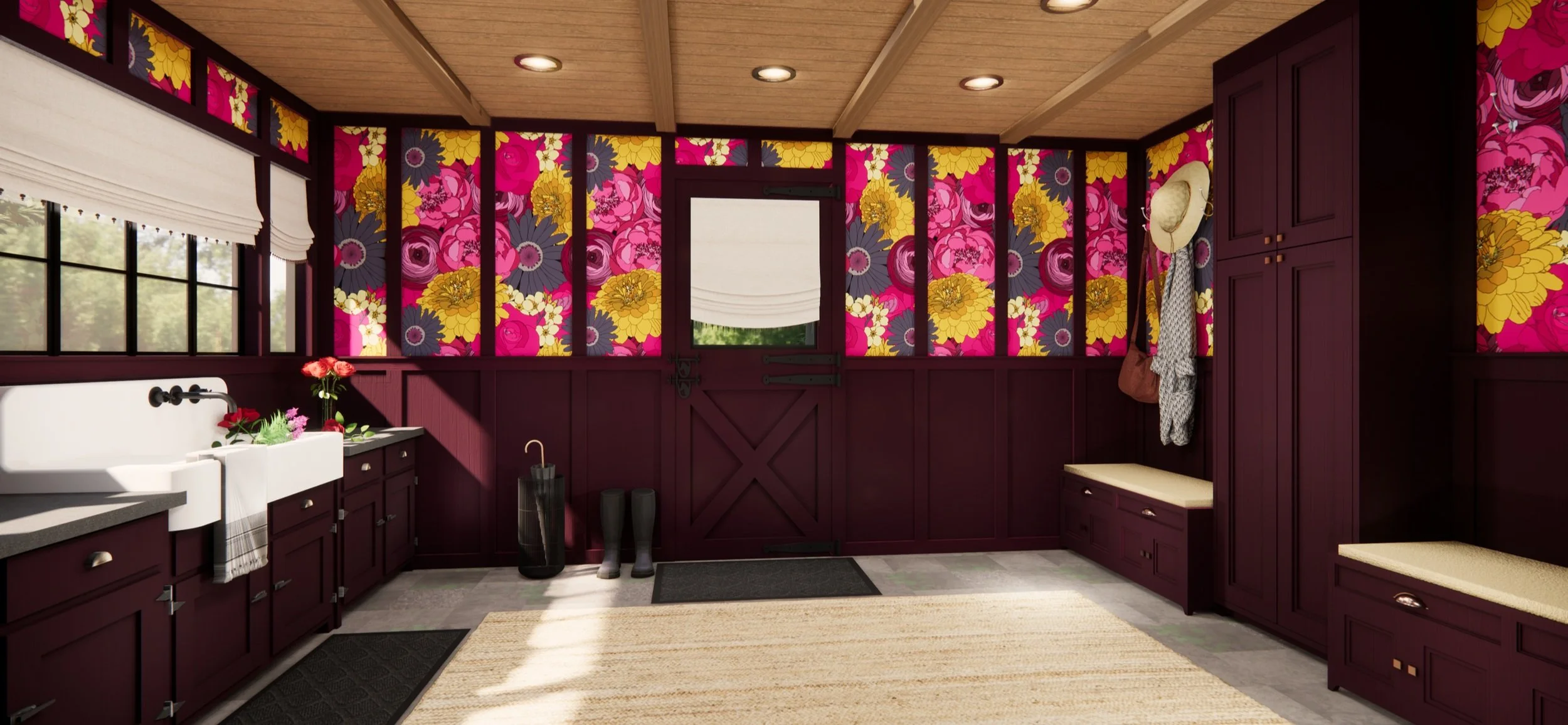
High-performance spaces—mudrooms, family rooms, kitchens, offices, even commercial showrooms—do a lot. They catch messes, hold movement, and flex constantly around whoever is using them. But even the hardest-working rooms can feel calm and grounded when pattern borrows from the outside world. In this post, I’m exploring how nature-inspired wallpapers and fabrics bring the feeling of “outside” in, and why that matters for the way we move, rest, and reset in busy spaces.
Why “high-performance” spaces need calm as much as durability
When we talk about high-performance spaces, we usually start with practical questions:
Will this stand up to shoes, paws, backpacks, and deliveries?
Will this fabric survive food, coffee, craft projects, or client meetings?
Will this wallcovering tolerate traffic, commercial lighting, and constant use?
Those questions are important. But there’s another layer that matters just as much: how these spaces feel to those using them every day.
High-performance rooms are often:
The first place someone lands when they walk in the door.
The backdrop to rushed mornings, late work sessions, or the “everyone’s home at once” hour.
The spaces that pick up the most visual noise—gear, paperwork, laundry, bags, equipment.
If the materials in those rooms only shout “wipeable” and “practical,” they can start to feel a little harsh or transactional.
Nature-informed pattern softens that. It doesn’t change what the room needs to do, but it changes how the room holds all of that activity.
What it means to “bring the outside in” with pattern
Bringing the outside in isn’t only about literal leaves or flowers. It can be as much about rhythm, palette, and line quality as it is about recognizable motifs.
Here are a few ways pattern can echo the natural world:
Botanical and leafy motifs that suggest gardens, forests, or fields without feeling overly sweet.
Organic geometrics that feel like ripples, pebbles, or woven grasses.
Softly scenic suggestions—the sense of horizon, sky, or canopy without a literal picture.
Palettes rooted in landscape: greens, blues, ochres, natural stone neutrals, and softened earth tones.
These gestures give a space a sense of connection—to seasons, to weather, to something beyond the tasks on the calendar. In rooms that ask a lot of those using them, that connection can be surprisingly regulating.
How organic pattern calms the nervous system in busy rooms
High-performance spaces are often where noise, clutter, and visual input are highest. Nature-inspired pattern can help regulate that, even when the room is in full use.
Nature-inspired patterns to:
Mimic familiar natural rhythms — Repeating leaves, grasses, or flowing lines echo patterns we know from walks, gardens, and landscapes. The brain reads them as familiar—comforting rather than demanding.
Diffuse hard contrast — Busy rooms often have a lot of “hard” contrast (screens, tile, metal). Organic motifs soften these transitions, especially when rendered in layered, tonal palettes.
Invite breath and pause — When users of the space look up from a laptop or away from the stove and see something gently organic rather than a blank wall, they’re more likely to take micro-pauses—which add up to feeling less fried by the end of the day.
A leaf repeat in a family room is doing quiet nervous-system work that a plain painted wall simply doesn’t.
The psychology: why nature-inspired pattern calms busy rooms
There’s a reason so many of us feel better after a walk outside. Our brains and bodies respond to:
Repetition with variation – the way leaves echo each other without being identical.
Soft edges and curved lines – which tend to feel more approachable than sharp, hard angles.
Layered neutrals and muted color families – which allow the eye to rest rather than constantly refocus.
Color as transitional ease – a larger scale pattern with tempered contrast, deep jewel tones, warm neutral paneling, and soft goods — helps both welcome the outside in and visually prepares us for nature outside.
Nature-inspired patterns borrow those qualities and bring them indoors. In high-performance spaces, this can:
Reduce the feeling of visual chaos when there’s a lot happening.
Give the eye a gentle “resting spot” even when counters or surfaces are busy.
Shift a room from feeling purely functional to feeling quietly (or richly) supportive.
Think of it as offering a small exhale in the middle of a workhorse space.
Where nature-inspired wallpaper shines in hardworking rooms
Every high-performance space has slightly different needs, but there are a few zones where bringing the outside in works especially well
1. Mudrooms, entries, and “drop zones”
These are threshold spaces: people (and animals) are coming and going, gear moves in and out, and weather often follows.
Nature-inspired pattern can:
Make the transition from outdoors to indoors feel more gradual and gentle.
Help camouflage scuffs and daily life, especially when paired with performance fabrics or durable wallcoverings.
Turn a purely practical area into a small moment of beauty—something those using the space see every single day.
Wallpaper that suggests foliage, branches, or a loose, organic stripe can wrap a mudroom in a way that feels embracing rather than fussy.
2. Kitchens and breakfast nooks
Kitchens are often the busiest rooms in a home or studio. They’re also where small routines stack up: morning coffee, kids’ breakfasts, late-night tea, or between-meeting snacks.
Bringing the outside in here might look like:
A botanical or abstracted leaf pattern on a breakfast nook wall.
A nature-informed fabric on café curtains, a banquette, or chair seat covers.
Subtle, water-inspired textures in upholstery or cushions.
Pattern in these areas doesn’t need to be loud. Even a soft, tone-on-tone botanical can make someone feel more grounded when they sit down between tasks.
3. High-traffic hallways and circulation paths
Hallways are often overlooked, but they carry a lot: footsteps, conversations, transitions between focus and rest.
Nature-informed pattern can:
Turn a pass-through into a small experience, rather than “just the space between rooms.”
Give those moving through a sense of continuity, like walking under tree cover or along a path.
Help manage scuffs and smudges by replacing expanses of plain, easily-marked wall.
Subtle, repeating organic motifs can make a hallway feel less like leftover architecture and more like a small journey.
4. Offices and studio spaces
Whether it’s a home office, design studio, or commercial workspace, these rooms carry concentration, deadlines, and meetings.
Bringing the outside in can support:
Focus, by giving the eye a calm secondary field when screens and paper dominate.
Comfort, by balancing harder surfaces (desks, screens, storage) with softer, nature-informed imagery.
Identity, especially for creative businesses that want their environment to tell a story.
Wallpaper behind a desk that echoes leaves, water, or woven textures can become a quiet backdrop for video calls and in-person conversations.
Choosing the right kind of nature-inspired pattern
Not every botanical or organic print will calm a space. Some are intentionally bold, dramatic, or high contrast—and those have their place.
For high-performance rooms where calm is a priority, I tend to look for:
Soft or moderate contrast – enough clarity to see the pattern, but not so stark that it shouts.
Organic line quality – hand-drawn edges, brush strokes, or gentle texture.
Rhythms that feel steady – repeats that are neither too tight (which can feel busy) nor too sparse (which can feel unresolved).
Palettes that can talk to real-life finishes – cabinetry, flooring, countertops, and existing furniture.
In my own work, I think about how a pattern will sit next to:
Wood tones.
Stone or solid-surface counters.
Tile, hardware, and textiles already in motion in the room.
To really support calm in busy spaces, it helps when your textiles echo the same message as your walls. Think about pairing:
Performance fabric in nature-led palettes — Durable, stain-resistant textiles in greens, blues, warms clays, or soft neutrals carry the outdoors-in story onto benches, dining chairs, ottomans, and sofas.
Organic pattern on upholstery or cushions — Leaves, grasses, or softly broken geometrics on a seat cushion or pillow can echo what’s on the walls—even if you scale down or simplify the motif.
Texture that feels grounded, not slick — Linen blends, textured weaves, and soft chenilles feel more like cloth and less like plastic. In a high-performance space, choosing practical fabrics that still feel tactile and natural helps the whole environment read calmer.
The combination of organic imagery + tactile comfort + durability is what lets these rooms, that carry heavy use, feel comfortable, friendly — even luxurious. The goal is not to copy nature literally, but to borrow its sense of ease and continuity.
Pattern + performance: making sure calm doesn’t feel fragile
High-performance spaces still need materials that can handle their jobs. Calm shouldn’t equal precious.
When I’m pairing nature-inspired pattern with performance needs, I look at:
Performance wallpaper substrates – options that are scrubbable, more resistant to impact, or rated for commercial use where needed.
Performance textiles – fabrics with stain resistance, higher double-rub counts, or tighter weaves that stand up to frequent use.
Pattern density – designs that can disguise the little marks and smudges that accumulate over time.
The aim is for those using the space to feel relaxed living in the room, not worried about every touch. The right pattern and material combination should invite daily life in, not keep it out.
For more information about high-performance textiles see my blogs entitled: “Performance Fabric Isn’t Just for Kids and Pets — Choosing Upholstery That Stands Up to Real Life”, “Designing for Real Life: How Pattern Hides Wear, Tear, and Imperfection”, and “Non-pasted, Grasscloth, Metallic, Vinyl – Choosing the Right Wallcovering for the Job”.
Functionally nature-inspired
For those who assume pattern is frivolous or fussy—especially in hardworking rooms, consider these:
Functionally, the right pattern and colorway will soften all the hard surfaces in a space and make the room feel less visually loud, even on busy days.
Feeling first; when an organic pattern matches the emotional intent for a room, there is calm with productivity or simple rest — whichever is desired.
Visual and practical performance is achieved when pairing a nature-inspired wallpaper with performance fabrics and wipeable surfaces. This results in durability with the nature-inspired pattern carrying how the room feels rather than replacing practicality.
Organic pattern is there to support desired energy
A few questions I like to ask when choosing nature-inspired pattern for hardworking rooms
What kind of calm does this room need—soft focus, gentle energy, or a feeling of being “held”?
Where will eyes land first when someone walks in? Could that surface carry a nature-informed pattern?
How much visual noise does this room already carry (appliances, open storage, equipment)? Does this pattern help soften that, or add to it?
Which materials are already present—stone, wood, metal, glass—and how can pattern echo or complement those?
Often, a single well-chosen nature-inspired wallpaper or fabric can do more for the feeling of a room than adding more objects or decor.
What I like to pay attention to
For those living or working in a space, you don’t need to know anything about pattern theory to notice what works.
You might ask yourself:
Do I feel slightly more relaxed when I’m in this room, even if nothing else has changed?
Does the pattern feel like it supports my routines rather than distracting from them?
Does this room feel connected to the outside world, even on days when I don’t leave the building?
If a pattern helps you answer “yes” to questions like these, it’s doing quiet, valuable work in your daily life.
If you’re planning updates to a high-performance space—a mudroom, kitchen, hallway, office, or showroom—and want to bring more calm without sacrificing durability, I’d be glad to help you think through pattern options.
For interiors professionals, we can:
Look at your existing materials and architecture,
Identify where nature-informed pattern could support the mood and function of the space,
Consider custom patterns, and
Match wallpapers and fabrics to the level of performance the room needs.
If you’re an interiors professional and you’d ever like a second set of eyes, this is where I love collaborating—helping you map pattern choices to architecture, function, and emotional tone.
And, for those using the space day to day, that are curious about how my nature-inspired patterns might look in your own home or workspace? You can request samples directly from any collection page by clicking “Request A Sample” on my website, and we’ll explore which motifs feel the most grounding for you. You’re welcome to explore my wallpaper and fabric collections, notice what you’re naturally drawn to, and then reach out to me if you’d like to work with me as your interior decorator.
Subscribe on my site for more design insight on pattern psychology, performance, and how to create rooms that work hard while still feeling like places to breathe. Receive new articles weekly in your inbox and instant access to two free printable substrate guides (wallpaper & fabric), plus a bonus PDF on Conscious Creators of Gentle Textiles.
© 2025-2026 Gabrielle Hewson. All rights reserved. You’re welcome to share links to this article, but please don’t copy or republish the text or images without my written permission. For licensing, permissions, or any other use beyond linking, please contact me directly.